 TM
TM
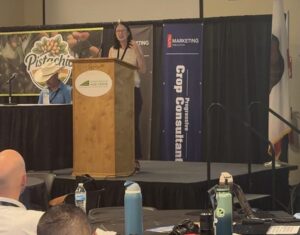
Understanding the dynamics of an uneven bloom and protecting the resulting smaller crop from insect damage before harvest were important topics at the JCS Marketing Pistachio Day event in Tulare.
Unique characteristics of pistachio pollen and an uneven, early bloom triggered by hot temperatures in March are contributing factors in this year’s projected short pistachio crop.
UCCE Tulare County farm advisor Elizabeth Fichtner explained the causes of low nut set and the implications for crop development, pest pressure and overall yield. This year’s early heat caused a “flash bloom,” which limited the number of viable pistils and affected nut set.
Pistachio trees evolved to be successful at pollen shedding, but pollen viability is critical. Pollen viability is related to blank and split percentages. Flower maturity, pollen availability and viability, and pistil receptivity are important factors in successful pollination and nut set.
In pistachios, apical buds open earlier, and basal flowers open earlier than distal flowers. Wind-driven pollen from male trees, even with the current 24-to-1 female-to-male ratio, can face steep odds in reaching and pollinating female flowers due to environmental challenges. Fichtner said pollen is shed over a two-week period, with the majority shed in seven to eight days. Most daily pollen is shed between 9 and 11 a.m. Based on atmospheric conditions and dispersal, pollination efficiency is likely higher during the morning hours.
Pollen Viability
Pollen viability affects fruit set. Wind enhances stigmatic pollen capture. Fichtner noted that windward-oriented flowers receive more pollen than those on the leeward side, and older inflorescences receive more pollen than younger inflorescences. Pistachio pollen tends to clump, she added, making it move differently through the air.
Fichtner said that 14 to 15 pollen grains per flower are needed for fertilization. Pollination increases stigmatic secretion and accelerates stigma degradation.
She noted that germination varies with flower age. It is highest on flowers that are 2 to 3 days old. Success declines after four days, resulting in misshapen nuts or fruit abscission.
In years when male and female pistachio flowers are asynchronous, supplemental pollination can help increase crop yields, but only under certain conditions.
Fichtner said some trials have shown a 12.7% yield increase and a higher percentage of split nuts with supplemental pollination. However, she cautioned that higher pollen levels may reduce yields when bloom is synchronous.
Fichtner also cited a 1993 study by UCCE farm advisor Steve Sibbett in which supplemental pollen was delivered to an orchard with a history of poor yields. The study found no effect on blank percentage or yields from the additional pollen.
Supplemental pollination may help improve crop yields when normal pollination processes fail. It could also be used to thin a crop during an “on” year to help mitigate alternate bearing. Fichtner noted supplemental pollination can also be useful in isolated orchards with limited pollenizers or when asynchronous bloom occurs during low-chill winters.
Dusty Conditions a Factor
Dusty conditions during bloom can also affect successful pollination. A combination of dust and herbicide damage to the stigmatic surface can result in lower fruit set and increased nut drop.
Growers with a crop this year are advised to pay close attention to pest management heading into harvest. UCCE area IPM entomology advisor Idongesit Mokwunye presented an overview of key pest pressures and timing strategies to protect both yield and crop quality.
Mokwunye said new-crop pistachios are at risk of infestation for eight to ten weeks, from early August through mid-October after hull split. Preventing navel orangeworm damage can lower reject percentages and maintain yield and quality. The goal, she said, is to keep damage below 1% as assessed by the processor.
“Pistachios are a vulnerable crop,” Mokwunye said. “Quantity and quality of a crop are compromised when larval NOW feeding occurs.”
Sanitation, including shaking, blowing nuts off berms, discing and flail mowing, is the foundation of navel orangeworm control. Good orchard sanitation deprives adults and larvae of shelter and food during the spring.
One challenge in pistachio production is that navel orangeworm develops on both the new crop and unharvested nuts from the previous year. This results in different generation times on mummy nuts and the new crop. There are overlapping generations from mid-July through September when generation time is shorter because of warm temperatures and abundant food sources. The moths move readily between orchards as crops mature at different times, causing populations to increase. Early shell split caused by water stress also increases damage potential.
While sanitation after the previous harvest is vital to keeping navel orangeworm populations under control, several in-season management options are available. The first is monitoring to achieve proper spray timing.
“Pest pressure is dynamic, and flight data serve as a guide to intensify scouting,” Mokwunye said.
There are different strategies for achieving optimal spray timing. Growers can use egg trap and pheromone combinations with degree days based on generation time for development or use 1,700 degree days as a biofix. Mokwunye said analysis of 16 years of flight data from Madera and Fresno counties found a consistent pattern of flight peaks when 1,700 degree days were used.
Other considerations for navel orangeworm control are orchard history and the presence of early or pea splits. Delayed harvest can increase pest pressure. Hull split creates an entry point for navel orangeworm, but it is unpredictable in pistachios.
Spray programs should target the most vulnerable stages: eggs and neonate larvae. Good spray coverage is essential, and different modes of action should be used for each generation to help avoid resistance development.
Mating disruption can also help keep navel orangeworm populations in check, but it works best when population levels are moderate. Orchard size and shape should be considered, and a regional approach to mating disruption may improve effectiveness.
Timely harvest is another key to keeping crop damage low. Harvesting before the late-season navel orangeworm flight is recommended. Timely harvest also reduces pest pressure on subsequent shakes and shortens crop exposure to navel orangeworm.
Publisher’s Take
The Big Picture: What to do Next
1. Early heat reduced this year’s crop
March’s “flash bloom” limited viable pistils, contributing to lower nut set and a smaller projected crop.
2. Pollen timing is critical
Successful pollination depends on viable pollen, receptive flowers and favorable weather during bloom.
3. Supplemental pollination has limited uses
It can improve yields when natural pollination is poor, but benefits depend on bloom conditions.
4. Orchard sanitation remains the first line of defense
Removing mummy nuts helps reduce navel orangeworm populations before the season begins.
5. Spray timing can make or break control
Monitoring pest flights and treating at the most vulnerable stages improves navel orangeworm management.

Cecilia Parsons | Associate Editor
Cecilia Parsons has lived in the Central Valley community of Ducor since 1976, covering agriculture for numerous agricultural publications over the years. She has found and nurtured many wonderful and helpful contacts in the ag community, including the UCCE advisors, allowing for news coverage that focuses on the basics of food production.
She is always on the search for new ag topics that can help growers and processors in the San Joaquin Valley improve their bottom line.
In her free time, Cecilia rides her horse, Holly in ranch versatility shows and raises registered Shetland sheep which she exhibits at county and state fairs during the summer.