 TM
Growers need to start early and stay vigilant when managing two weeds that can create havoc at harvest in hazelnuts.
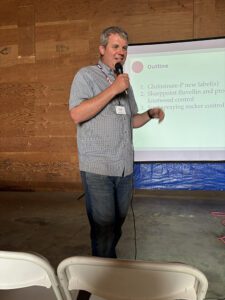
In a presentation at the Nut Growers Society 2026 Summer Tour Aug. 5 in Albany, Ore., Oregon State University Extension Weed Specialist Marcelo Moretti said trials have shown that despite good early-season control of sharp-point fluvellin and prostrate knotweed with a preemergence herbicide application, 90 days after treatment, the treatment was no longer holding back the weeds.
Growers will need at least two treatments, including a preemergence and a postemergence application, to effectively manage the problematic weeds, Moretti said.
When present at harvest, sharp-point fluvellin and prostrate knotweed can get tangled in sweepers and harvesters, leading to yield reduction. “That’s the big deal (with these weeds),” Moretti said. “If you cannot get the nuts off the ground and into the dryer, you didn’t grow it, right?”
Multiple Similarities
The two weeds have multiple similarities, Moretti said, including prolific seed production and a propensity to form dense mats on the soil surface. There are some significant differences, however, that can shape control tactics.
Prostrate knotweed, according to Moretti, emerges earlier than sharp-point fluvellin and stops germinating earlier. The optimal temperature for the weed is around 59 degrees Fahrenheit.
“I’m seeing this emerge out of the ground in late March to early April,” Moretti said. He added that exposure to sunlight promotes germination, so in shaded orchards, emergence might be delayed and, in some cases, halted altogether.
“If you cannot get the nuts off the ground and into the dryer, you didn’t grow it, right?” – Marcelo Moretti
“Once soil temperatures exceed 63 degrees Fahrenheit, the process that releases seeds from dormancy stops,” Moretti said. “That helps concentrate emergence early in the season, although seeds already released from dormancy can still germinate at higher temperatures. So, it is a very distinctive flush of germination.”
Comparatively, sharp-point fluvellin flourishes at higher temperatures, emerges later in the season and keeps germinating longer into the season. It can have multiple flushes over a season.
Like prostrate knotweed, fluvellin also flourishes under exposure to sunlight.
“So, once you have a lot of ground exposure, you will see a flush coming up,” Moretti said.
Application Strategies
In experiments, Moretti said he was able to attain good control of the weeds with a preemergence application of Spartan, or sulfentrazone, a Group 14 herbicide. Mixed with Zidua, or pyroxasulfone, the application also provided good control of annual bluegrass. Prowl or Satellite, pendimethalin, provided good control of prostrate knotweed, he said.
He noted it is important to apply preemergence herbicides early in the season, well before seeds germinate.
“If you wait until you see the weed, this is no longer a preemergence component. You have to use postemergence,” he said.
For postemergence applications, glufosinate-based treatments best controlled the two weeds, he said, but larger weeds often escaped the treatment.
The bottom line, Moretti said, is at least two applications are generally needed to control sharp-point fluvellin and prostrate knotweed.
“That is partly because the weed-seed bank is just tremendous,” he said.
And, he said, it is important to treat trunk to trunk because weed seeds can be moved under normal production activities.
“As you are sweeping, you kind of move the seed around,” he said.
Moretti said he is now looking at two new materials, including a new active ingredient that has shown good postemergence efficacy against prostrate knotweed. Researchers are working to get the herbicide Quelex registered for use in hazelnuts through the federal IR-4 Project.
The Hazelnut Industry Office reported that at least 700 people attended the annual tour and trade show, held at Third Knight Farms.
Publisher’s Take
The Big Picture: What to do Next
1. Start before emergence
Apply preemergence herbicides before weeds germinate rather than waiting until weeds are visible.
2. Plan on more than one treatment
Moretti’s trials indicate sharp-point fluvellin and prostrate knotweed generally require both preemergence and postemergence control.
3. Target weeds while they are small
Larger weeds were more likely to escape postemergence glufosinate-based treatments in the trials.
4. Treat the full tree row
Trunk-to-trunk treatment can help address weed seed that is redistributed during normal orchard operations such as sweeping.
5. Account for different emergence patterns
Prostrate knotweed emerges earlier, while sharp-point fluvellin can continue germinating later and in multiple flushes.