 TM
TM
Hairy fleabane and horseweed (marestail) are two problematic broadleaf weeds commonly found in California orchards and belong to the Conyza genus. Both species typically emerge during the fall and winter and bolt in the spring. Once bolted, they become difficult to control because plants can regrow after mowing and are less susceptible to post-emergence herbicides. Both species produce large quantities of wind-dispersed seed, and populations resistant to glyphosate and paraquat have been documented in California.
Management
Pre-emergence herbicides are an important tool for managing hairy fleabane and horseweed. Herbicides such as indaziflam (Alion), flumioxazin (Chateau), rimsulfuron (Matrix), oxyfluorfen (Goal 2XL), mesotrione (Broadworks), isoxaben (Trellis SC), penoxsulam + oxyfluorfen (Pindar GT), and orthosulfamuron (Craze) can provide residual control when applied during the fall and winter months.
Post-emergence herbicides such as glufosinate (Rely 280), saflufenacil (Treevix), pyraflufen-ethyl (Venue Max), carfentrazone (Shark) and 2,4-D (Embed Extra) can also be effective when applied to small, actively growing weeds before the bolting stage. Glyphosate (Roundup PM) and paraquat (Gramoxone) herbicides can also be effective on susceptible weed biotypes.
Post-emergence herbicides such as glyphosate and paraquat continue to be heavily relied upon in orchard systems to maintain clean orchard floors for harvest. Herbicides with different modes of action should be rotated and used with effective tank-mix partners to reduce selection pressure for herbicide-resistant populations. Proper timing of pre- and post-emergence herbicides, along with controlling weed escapes before seed production, are important components of resistance management.
New Herbicide Options
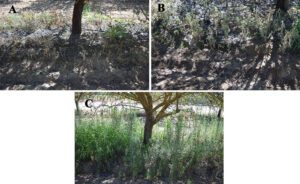
In 2025, Corteva registered the herbicide Hulk (florpyrauxifen-benzyl) for use in nut orchards, citrus and other orchard systems. Florpyrauxifen-benzyl is a synthetic auxin herbicide (WSSA Group 4), the same herbicide group as 2,4-D. Synthetic auxin herbicides are effective for controlling broadleaf weeds such as hairy fleabane and horseweed, including populations that are resistant to glyphosate.
Unlike 2,4-D, florpyrauxifen-benzyl has lower volatility and can provide growers with greater flexibility for use during the growing season when applied according to the label. Hulk has activity only on broadleaf weeds and is labeled for control of horseweed, hairy fleabane, lambsquarters, filaree and mallow. The product has a 60-day preharvest interval, making application timing an important consideration.
Herbicide Trials
In 2025, an herbicide study was conducted by weed science farm advisors Jorge Angeles, UCCE Tulare, Kings and Fresno counties, and Mandeep Riar, UCCE Kern County, to evaluate the weed control efficacy of Hulk in an almond orchard.
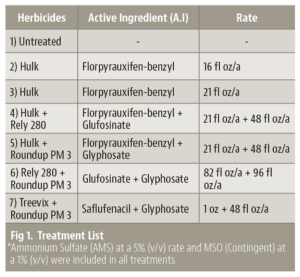
The herbicide trial was conducted in an almond orchard in Shafter that had a high population of hairy fleabane and horseweed. The treatments included standalone applications of Hulk, tank mixes with other post-emergence herbicides and comparisons to standard treatments of glyphosate + glufosinate and Treevix + glufosinate (Fig. 1).
The sprayer was calibrated to output a carrier volume of 20 gallons per acre. At the time of application, the only weeds present were hairy fleabane and horseweed, averaging 11.5 and 10 inches tall, respectively.
Ammonium sulfate (AMS) at a 5% (v/v) rate and MSO (Contingent) at 1% (v/v) were included in all treatments.
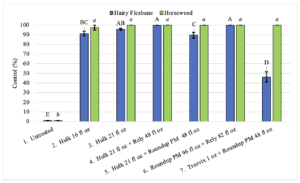
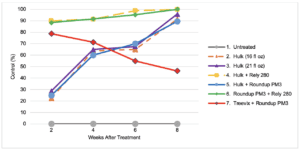
Weed control data was recorded biweekly for a total of eight weeks. At two weeks after treatment (WAT), treatments containing Rely 280 provided more than 85% control of hairy fleabane, while Treevix + Roundup PM3 achieved 79% control (Fig. 3).
The Hulk + Rely 280 tank mix consistently provided the fastest and highest level of control.
In comparison, standalone Hulk and Hulk + Roundup PM3 provided less than 30% control at this timing. However, control from the Hulk treatments progressively improved over time. By eight WAT, all Hulk treatments provided more than 90% control of hairy fleabane, with the Hulk + Rely 280 treatment achieving 100% control (Fig. 3).
Treevix + Roundup PM3 provided the lowest control at eight WAT due to significant hairy fleabane regrowth.
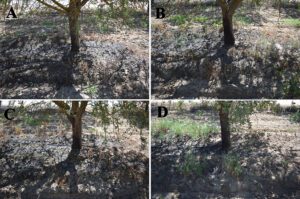
Horseweed was more susceptible than hairy fleabane, with all treatments providing high levels of control by eight WAT and most achieving 100% control (Fig. 2). Although the average weed height at application was approximately 10 inches, all treatments except Treevix + Roundup PM3 provided excellent control of both Conyza species.
The slower activity observed with standalone Hulk treatments suggests florpyrauxifen-benzyl requires more time to fully express herbicidal activity on these species.
Take-Home Points
All Hulk treatments provided excellent control of hairy fleabane and horseweed by eight WAT, with horseweed appearing more susceptible to florpyrauxifen-benzyl than hairy fleabane.
The Hulk + Rely 280 tank mix consistently provided the fastest and highest level of control, with early burndown activity comparable to the top label rate of Roundup PM3 + Rely 280.” Although some hairy fleabane plants treated with standalone Hulk remained green at eight WAT, they showed herbicide symptoms and exhibited no regrowth.
In contrast, Treevix + Roundup PM3 resulted in significant regrowth and the lowest level of control.
These results suggest Hulk, alone or in combination with Roundup PM3 or Rely 280, can provide effective control of glyphosate-resistant Conyza species and serve as a valuable rotational or tank-mix partner in nut orchard weed management programs.
Publisher’s Take
The Big Picture: What to do Next
1. Control weeds before bolting
Hairy fleabane and horseweed become much harder to control once spring bolting begins.
2. Resistance remains a major concern
Glyphosate- and paraquat-resistant Conyza populations are established in California orchards.
3. Rotate herbicide modes of action
Effective resistance management requires herbicide rotation and tank-mix partners.
4. Hulk showed strong performance
All Hulk treatments provided more than 90% hairy fleabane control by eight weeks after treatment.
5. Hulk + Rely 280 delivered the best results
The tank mix consistently provided the quickest and most complete control in the trial.