 TM
TM
“You have to be good to do it. The soil and water have to be right to farm organic pistachios.”
Setton Farms Grower Services Manager Mike Smith should know. He has been piloting this pistachio farming and processing company’s organic sector for the last 10 years. In that time, Smith has watched the number of acres in organic production grow to 4,500, including seven member growers. Setton is the largest producer and processor of organically grown pistachios in California. Setton also has a separate, dedicated facility for its organic lines.
While there are arguably plenty of good farmers producing both organic and conventional pistachios, Smith said it takes real attention to create a healthy environment in orchards so trees farmed organically can produce quality, high-yielding, marketable crops. Setton and its organic grower partners are able to meet quality goals. Smith said the reject levels of conventional and organic are comparable.
Extra Work, Premium Returns
There is extra work involved in producing a quality crop of organically grown pistachios. Smith confirmed that the most common reason growers opt to put acreage into organic production is the return on investment. Market demand for organic products is growing, he said, and growers are paid a premium for quality.
Smith said orchards are typically started with conventional methods and then transitioned into organic production once the trees have a good start.
“That’s because young pistachio trees don’t compete well with weeds,” he said. Weed control is the most problematic issue in organic production, particularly in young orchards with small canopies.
Weed control in Setton’s organic orchards consists of burning and hand labor, with labor being a major expense, Smith acknowledged. For the first couple of years, trees need a weed-free environment if they are to reach yield potential.
There are a few more options for pest control. Houston Wilson, UCCE specialist, in a 2022 report noted that three products approved by the Organic Materials Review Institute: AF36, sulfur and petroleum-based oils, accounted for nearly all pest-control materials in organic pistachio production.
Organic herbicide options are limited. Growers are advised to scout early for weed emergence and use control measures before the weeds mature.
Dedicated Organic Processing
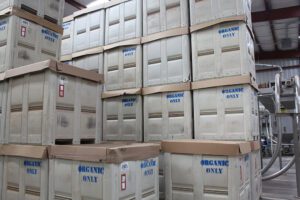
Setton’s dedicated organic processing facility is located in Ducor, just a few miles south of its main processing facility. It opened in 2021, processing about 1 million pounds the first year. Production Supervisor Alfredo Maciel said volume arriving at the plant is now in the 12 million-pound range and the plant is in operation year-round.
“We’ve had a second shift working since October and I expect that to continue,” Maciel said.
Setton’s second facility west of Terra Bella receives all the organic product in a dedicated part of the plant where it is hulled, dried and stored.
Roastery in Ducor
It is shipped to Setton’s Roastery in Ducor to fill orders.
The nuts are electronically sorted, removing closed-shell nuts and stained shells. Nuts are also sorted for size and color. They also pass by human eyes to remove smaller imperfections. Kernels are extracted for kernel products. The nuts undergo pasteurization at the plant and are kept in cold storage to preserve quality. A final processing step for some product is roasting, and some are salted.
Setton vacuum-packs orders into 25-pound boxes for in-shell nuts and 30-pound boxes for kernels. The finished products are sent to the Terra Bella plant for shipping.
Grower Focuses on Soil Health
Porterville-area pistachio grower John Billiou is one of Setton’s seven organic producers. He readily admits he is not an expert in farming, but he looks at his 27 acres of organically farmed pistachio trees as a good business decision.
“I don’t know farming, but I do know finance, and yield from these trees will rise in value as organic pistachios and offset costs of production,” Billiou said.
His mature Golden Hills trees were planted and grown conventionally until four years ago when they were transitioned to organic production.
In the process, Billiou said he has become more familiar with the regenerative practices used in organic production and is focusing on soil health. That includes understanding the nitrogen that is in the soil and how the trees use that nutrient.
He said weed growth was an early issue with the organic transition and, being accustomed to a clean orchard floor, it was difficult to see weeds in the orchard. However, he said the native grasses and cover crops he plants do play a part in orchard soil health, spurring microbial activity and healthier soil. He said the cover crops are mowed two to three times per year.
The relative isolation of his orchard, Billiou said, likely contributes to the low level of navel orangeworm damage in his crop. He does use mating disruption to keep resident populations low. Plant bugs are another story. They move into the orchard from neighboring fields when those crops dry up. Billiou said he uses diatomaceous earth, blown on the trees, to control plant bugs.
Early harvest, he said, is important for keeping insect damage low. Setton’s harvest crew will typically do one to two shakes, two weeks apart, to get more of the crop off.
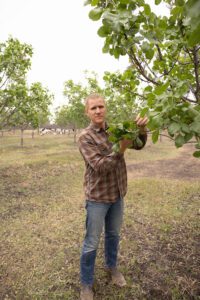
His reject level, Billiou said, has been in the low single digits, but higher than his previous conventional harvest. The premium he receives for his crop, he said, makes up the difference.
Organic Challenge Pays Off
Kern County organic pistachio grower Daniel Palla said he chose to transition his pistachio orchard to organic production for a challenge.
“Pistachios are easy to grow,” Palla said. “I wanted a challenge and it has turned out better than expected.”
Keeping his Golden Hills trees fed has not been an issue with Palla. He noted the resilience of mature pistachio trees and their ability to mine deep into the soil for nutrients.
Where he found a challenge was in weeds during the transition to organic production. Palla said he tried burning, but found that, besides being dangerous, it was uneconomical. His current weed-control program consists of a flock of sheep that are contained with electric fencing and moved around the orchard. The sheep not only keep the weeds in check, they also provide sanitation by eating the mummies on the ground.
While the sheep have come with their own set of challenges, Palla said after a few growing seasons he has fine-tuned his stocking rate per acre and become familiar with using electric fencing. What remains a problem are people who knock down the fencing with their vehicles.
Palla’s primary pest-control tool is mating disruption. The earlier-maturing Golden Hills variety allows for an early harvest, and his reject level has been less than 1% for the past two years.
“Financially, it has been a good decision to go organic,” he said.
Publisher’s Take
The Big Picture: What to do Next
1. Organic pistachios can command a premium
Growers cited improved returns that offset higher production costs and reject rates.
2. Weed control is the biggest challenge
Young trees struggle to compete with weeds, making early-season management critical.
3. Organic production requires more labor
Hand labor, burning and alternative weed-control methods can significantly increase costs.
4. Healthy soils become a priority
Cover crops, regenerative practices and nutrient management play larger roles in organic systems.
5. Early harvest and mating disruption help manage pests
Organic growers reported success controlling navel orangeworm and maintaining low reject levels with these strategies.

Cecilia Parsons | Associate Editor
Cecilia Parsons has lived in the Central Valley community of Ducor since 1976, covering agriculture for numerous agricultural publications over the years. She has found and nurtured many wonderful and helpful contacts in the ag community, including the UCCE advisors, allowing for news coverage that focuses on the basics of food production.
She is always on the search for new ag topics that can help growers and processors in the San Joaquin Valley improve their bottom line.
In her free time, Cecilia rides her horse, Holly in ranch versatility shows and raises registered Shetland sheep which she exhibits at county and state fairs during the summer.