 TM
TM
Madera grower and crop consultant Will Cosyns reflects on taking on the family operation at 25 and where he sees opportunity for California almonds
Will Cosyns of Diamond C Farming was 25 and working to finish up his college degree when the trajectory of his life changed with the unexpected death of his dad. Suddenly, he went from helping out with harvest to being one of the people making decisions for the family business, which includes 350 acres of almonds.
Cosyns said being able to step in and learn what he needed to know is one of his proudest achievements.
“I wasn’t really involved in any management of it prior to my dad passing away,” Cosyns said. “And I know my first year was pretty rough, but since then, I think I’ve really, really improved on quality and yield. Seeing that number on how many pounds I produce every year go up is a good feeling.”
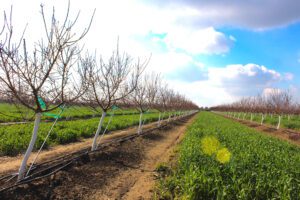
We asked Cosyns to share his thoughts about his farming experience and the nut industry in general:
Tell us about the history of your farming operation.
I’ve been in it my whole life. My family’s been farming for a long time. My grandpa, my dad’s dad, started down south as a sharecropper at the Bixby Ranch, I believe. Then he moved his operation up here to Madera. We were row crop farmers, mainly black-eyed peas, cotton, corn. We started diversifying into permanent crops like grapes, winery grapes and almonds, and later pistachios, as well.
When did your dad take over?
My dad and my uncle took over the operation, and they were running it until about 2021 when we sold quite a bit of property. We kept about 800 acres, and I’m farming 500 acres of it. My uncle is still farming 300 acres of the original home ranch.
Fertilizer pricing has definitely influenced people’s desire to make sure that they’re putting it on at the right time, in the right place, at the right rate. — Will Cosyns
When did you join?
I came in 2021 when I kind of just got dropped into it. My dad passed away in September of ’21, and I went from still being in school to trial by fire. We were in the middle of harvest, and I was running all the grape harvesters at the time and helping out with the pistachios and almonds.
Did you try to finish school, or did you just come home and run the ranch full time?
I tried to, and I was also at the time working full time for Helena Agri-Enterprises as a salesman. So juggling that and the ranch and school was tough. I had my PCA license and my CCA license at the time, and I was pretty confident in my abilities doing that. I just could not juggle it all. I was a couple semesters away from finishing. I’ll go back at some point, I think, but I just couldn’t do it all. It was a lot to juggle. I worked 20 hours a day sometimes working both those jobs.
I work part time now. I left last year. I actually worked there for 10 years. And now I’m doing my own independent consulting around Madera and Fresno counties.
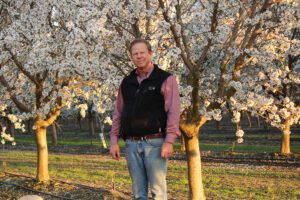
Tell us about that.
I do crop consulting—crop protection, crop production. I really zero in on precision agriculture. That’s my little niche, you would say, agronomy and whatnot. The crop protection side is not easy, but I think fairly simple to me. I just see a lot of these Midwest guys are really precise with their fertilizer inputs, and I don’t see a lot of that around here. We’re seeing it more and more, but in terms of equipment, we’re kind of limited.
How have farming practices evolved in the time you’ve been on the farm?
We’ve gone to tighter plantings on the trees. I remember a couple of older blocks that we had. We had 23- or 24-foot by 20-foot spacing on the trees. Obviously, we’ve seen a lot of advancement in irrigation.
On the fertility side, I think we’ve seen a lot, especially with fertilizer prices going up. I think you see a lot more people really watching their inputs and pulling tissue samples, soil samples to make sure that their trees are at optimum levels and also that they’re not over-applying.
In terms of like uniformity, there’s a lot more focus on making sure that your drip system is properly calibrated and is operating at a good level of efficiency and uniformity across the field. I see that’s gotten a lot better. I think people are learning more and more about it as the years go by.
What do you think is driving that interest? Water? The cost of fertilizer?
I think it’s both. We’ve been really blessed the last couple of years in California with good rain seasons and good ditch water seasons if you’re in an irrigated area. I think it’s maybe slipped a little bit just because we’ve gotten comfortable having enough water around.
But when we’re hitting a lot of drought and there was a lot of pumping going on, there was a lot more focus on monitoring how many hours we need to run. Whereas I think now people are a little bit more liberal with their water because we’re getting ditch water, and it’s cheaper to pump ditch water.
Fertilizer pricing has definitely influenced people’s desire to make sure that they’re putting it on at the right time, in the right place, at the right rate.
What keeps you up at night about growing nuts?
I usually have water running overnight, so I hope something’s not going on with the pump that I can’t see and I’m not going to make a lake on the road and my neighbor is going to drive by and get a good laugh out of it.
Then hoping that I’ve taken all the right steps throughout the season to make a good quality crop that is going to yield a good harvest and just make me some money.
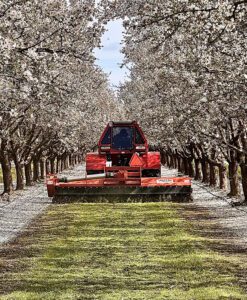
Talk a little bit about what it was like to become a decision-maker in the business overnight.
I still had my uncle around, and we just split the workload. My dad was a lot more involved with the grapes. That kind just got passed down to me, running the harvesters and everything. It was just being out there to make sure everything’s being done properly.
My uncle kept on running the almond crew. We didn’t have our own pistachio equipment. So, I was going out to the pistachios and checking to make sure when they’re going to be ready to harvest and whatnot.
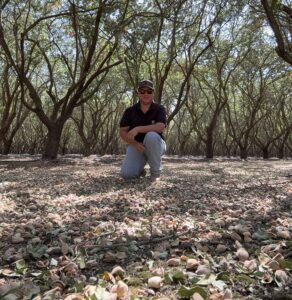
It was a lot of long nights. We were night harvesting the grapes, and I’d go out and check fields and do my day job and then get home, maybe take a quick nap and jump in my truck and drive out to wherever we were harvesting that night, get the guys started. I’d stay out there until 11 or midnight, go home, get another quick couple hours of sleep and then go back out to make sure everything went well and make sure that the equipment was being maintained after the night and start solving any problems that there might have been that night.
What would you say you’re most hopeful for in the future when it comes to nuts?
Obviously, price is probably the number one thing. I want to make sure we have a good price and we’re making money to keep us farming. I hope that we see some more advancements in precision agriculture and permanent crops. That’s something that I think is moving a little bit slower.
Like I said, that’s kind of my little niche, so I’m hoping for more of that and that they keep improving on everything in general: varieties and crop protection products, crop production products. We could produce a better crop and a safer crop than what we produce right now.
What kind of precision ag tools would you like to see?
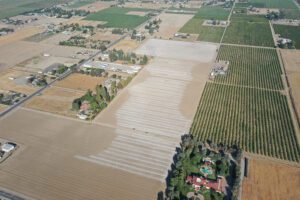
The thing that I’ve really been stuck on is variable rate spreading for dry fertilizers. In some areas it’s not that big of a deal, but at least around this area, there’s a lot of striations in the dirt.
You go from sandy to heavy, and you pull soil samples in different areas where your pH can be seven over here and four over there. It’s just something that’s difficult to manage without having those tools, and it could really impact your crop.
For example, just around my house, I have some trees right now that are not that far from being shaken and probably some trees in the same field, maybe even in the same row that could be seven days behind. Just trying to even that out makes for a more productive crop, and it makes for a more efficient operation.
I’m not having to worry about, “Man, do I need to come back and shake this little area of the field and deadhead a couple rows here and there?” because the soil is different. Obviously, you can’t change the soil texture, but you can get them as close to being mature at the same time as possible.
When I was working at Helena, we had a program that we did called High Ground that is basically a giant magnet that you drag across the field, and it would measure the electrical conductivity in the soil.
They’d take soil samples based off of that, and you would get a map that shows you basically everything that a soil sample can show you. It’ll show you you’re low on potassium in this area, you’re low on phosphorus in this area.
And then they have a spreader that is set up to spread those variable rates of gypsum, lime, sulfur, that kind of stuff.
I think the technology is out there. You might need to make some adaptations to it to make it work in orchards.
Learning to run the equipment is probably one of the biggest hurdles because with some of the employees that we have there’s maybe a language barrier or maybe they just don’t understand exactly what’s going on with this computer that now instead of me just turning this machine on and off, now I have to worry about it spreading the right rate and that kind of stuff.
What do you think the almond industry needs to do to be on the best path for the future?
I think we’re on a really good path right now. I know we had some pretty big crops that came in, and we took a hit on price. But it’s really come back from those days just in the past couple years.
I’m seeing some price sheets with over $3 a pound on them for certain varieties. So I think we’re headed in the right direction.
What would you say are the biggest assets of the nut industry in California?
I think our ability to produce a good, clean, safe crop. We can produce a good crop most every year. Mother Nature is going to do what Mother Nature does, but I think for the most part, California is the most efficient at producing almonds.
Who would you say had the biggest influence on you as a grower?
My dad is going to be the biggest one. He was really good at what he did and took a lot of pride in running a good, clean, efficient operation. I think that’s where I got a lot of that.
What do you think the biggest advancement has been in the time that you’ve been farming?
I have been farming on my own for a very short time, but just being around agriculture, I think one of the bigger things has been some of these self-pollinating varieties. It’s making for an easier harvest, especially for some of the smaller farmers that are having to have a custom harvest crew come in. It’s just one and done.