 TM
TM
August usually means the start of almond harvest, but shakers started early this year. Key August practices in almonds include limiting water stress through harvest and reducing shaker damage, while delivering a clean, high-quality crop.
Protect Trees Through Harvest
Irrigation: Avoiding sustained periods of moderate to high water stress in almond orchards from hull split to leaf drop is a key deliverable in almond production. Why? Flower bud differentiation begins before harvest, during or before hull split, depending on the variety, and continues through leaf drop. Prolonged periods of moderate to high water stress, negative 14 to negative 30 bars measured with a pressure chamber, from hull split into the fall can impact flower development and limit future yield. How much yield loss? In an extreme example, Nonpareil yield was reduced by 40% the following year when no postharvest irrigation was applied.
Manage Water Stress After Harvest
To avoid extended water stress, restart irrigation as soon as possible after shaking. Sweeping and conditioning nuts into wide, thin windrows within a day or two of shaking is becoming a common practice where growers can keep irrigation water off the windrows. This practice is important for all varieties in a planting. Some growers condition nuts to blow out the leaves and trash and speed drying. Once all nuts are up, the goal is to return the trees to between 2 and 4 bars below baseline, negative 10 to negative 14 bars on the pressure chamber, and keep that level through the fall.
Top growers make limiting water stress at harvest a priority. One grower with more than 1,000 acres only develops orchards with drip irrigation to limit harvest water stress. A couple of quick sweeper passes and the water is on. Another large grower uses microsprinklers at lower pressure to irrigate around windrows. Some growers are beginning to use dual irrigation systems: a microsprinkler system for irrigation, frost control and herbicide/fertilizer incorporation and a drip system for fertigation and harvest irrigation. Payment for the added cost of a dual system can be spread over the life of the orchard using a development loan.
Pest damage: Navel orangeworm, or NOW, is the major pest to consider in almonds at harvest. Timely harvest, shaking any time after all nuts in the orchard are at the 2c hull split stage, is an excellent, FREE tactic to limit worm damage. Nuts on the orchard floor are much harder for female moths to find and infest with their young by laying eggs. Timely harvest will drop greener nuts and should be combined with an effective ant control program, as a longer drying time on the orchard floor will probably be needed. Spraying later harvesting varieties can help reduce damage if trap monitoring and early crackouts show the damage risk is high. Higher spray volumes, 150 to 200 GPA, and slow sprayer speed, 2 mph, improve spray coverage and pest control in large, vigorous trees. Note: The preharvest interval for pesticides is based on shake date, not pickup, and most insecticides require at least seven to 10 days between spraying and shaking. Exceptions include B.t., (Javelin®, Dipel®, etc.), and Danitol®, with PHIs of zero and three days, respectively.
Shaker damage can shorten the life of individual trees and, in a worst-case scenario, entire orchards when poor equipment/labor management and harvest timing combine. Trunk damage opens the tree to fungal infection, Ceratocystis, etc., or invisible interior wood/cambial damage. An occasional barked tree is part of the cost of orchard mechanization. Two or more barked trees in a row is a management problem. The operator should stop the machine after the second tree is barked, or someone should tell the operator to stop. There is a problem with the machine, or the orchard is not ready to harvest. David Doll, The Almond Doctor, has an informative post on shaker damage listing five practices to reduce this damage. These include proper harvest timing, training/maintenance, adequate but not excessive nitrogen nutrition, good orchard irrigation distribution uniformity and delaying harvest for vulnerable, younger orchards to allow the cambium to strengthen. Almond trunk cambium tissue strengthens over time, so shaker damage risk is reduced with later harvest. To see The Almond Doctor post, Google “the almond doctor shaker damage.”
Harvest timing should be decided on an orchard-by-orchard basis. Waiting until the end of harvest to shake a third-leaf planting to allow the cambium to strengthen and so reduce chances of shaker damage will probably have more value in the long run than a one-time increase in reject nuts due to later harvest. Maybe more NOW damage is worth accepting to avoid damaging the 20-year investment in the orchard? On the other hand, how important is high-quality crop volume this year? It’s a grower call.
Vigorous rootstocks often result in later harvest dates due to later nut maturity. In the past, growers used different varieties to spread harvest timing. This is still a very viable practice, but some growers are now planting the same variety on a range of rootstocks to allow more acres of a valuable variety or combination of varieties to match the available harvest resources. Tighter tree spacings can improve production per acre on less vigorous but earlier-harvesting rootstocks.

Prepare for Fall Challenges
With current El Niño conditions here and forecast to strengthen into the fall and winter, reviewing protocols for rain at harvest, particularly in later-harvesting varieties, is worthwhile. In a nutshell, picking up wet nuts will hurt nut quality and may be very costly to the grower. See details on pickup and stockpiling in a UCCE Sac Valley blog post by Googling “Sac Valley orchards stockpiles.”
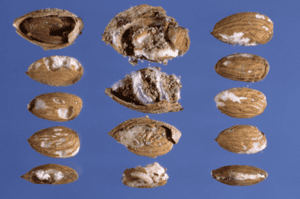
Take a harvest sample, 500 nuts per block, before sweeping. Crack out and evaluate the extent and source of nut damage to understand what pests cause the damage. If immediate crackout isn’t possible, freeze the samples until there is time to process them. This is an important activity, as it measures real crop loss, not what remains after harvest and processing steps. Knowing the extent and source of damage can help focus pest control dollars for the best return.
With possible very wet weather this fall/winter, it could be a good year to wait until January to prune young orchards. January pruning produced lower pruning-wound disease infection rates compared with the fall and early winter, September through December, pruning timings in trials by a research team led by Dr. Flo Trouillas, UC Davis plant pathology extension specialist. Infection rates of 80% to 100% at all pruning timings were recorded when pruning occurred immediately before rain. Thiophanate-methyl, Topsin-M®, etc., spray immediately after pruning consistently delivered the lowest infection rates in all UC trials in almond.
Nutrition: Hull samples are the best way to evaluate almond orchard B status. Sample dry hulls from windrows of different varieties, keep the samples separate and send them to the lab for boron, or B, analysis. If hull B levels are 100 ppm or lower, talk with your CCA about B fertilizer programs for this fall, foliar, and next spring, soil and/or foliar. A fall boron spray increased yield of well-managed almonds by 100 to 200 kernel pounds per acre in low-B-status orchards in UC research. Fall-applied soil B fertilizer won’t get into flowers in time to help improve nut set next spring. Hull B levels at or above 300 ppm indicate toxic levels of B in the orchard.
Walnut Priorities
Much like almonds, walnut kernels steadily accumulate dry weight through the months just prior to harvest; for walnuts, that’s August and September. Careful irrigation and fertilization keep leaves healthy and producing sugars to build nuts during this time. The last 25% of the annual nitrogen budget should be applied to bearing walnuts in August, or early August if the crop development is advanced. If July leaf tissues show low potassium, less than 1.2% leaf K, fertigating with liquid K, KTS, PotCarb, liquid SOP, etc., should be considered. Deficient orchards show leaf K levels of 0.9% or less, while the adequate K threshold is leaf K of 1.2% or more. KTS reduces soil pH; PotCarb or K-Acetate increases soil pH. Adequate K should help maintain sugar production, photosynthesis, sugar transport within the tree and water relations.
Spider mites feed on leaves and can cause defoliation if not managed. To keep leaves healthy and photosynthesizing to feed the nuts and increase kernel weight, manage spider mites where needed. Weekly monitoring should begin in June and continue into August. UC IPM suggests a miticide may not be needed if mites haven’t built up by mid-August. Spider mite treatment thresholds, ipm.ucanr.edu/agriculture/walnut/webspinning-spider-mites, vary with pesticide history, with or without pyrethroids or organophosphates, and percent predator presence on sampled leaves. Some husk fly materials can flare spider mites, so careful monitoring is needed following husk fly spray or sprays.
Ethephon is a tool to advance walnut harvest and improve nut quality. It is far too early to spray, but it is worth talking about this practice with your PCA. Check out a great new article on ethephon use in walnuts, with photos, by Clarissa Reyes, UCCE orchards advisor in Sutter/Yuba counties, at sacvalleyorchards.com/walnuts. Scroll down to Horticulture.
An occasional barked tree is part of the cost of orchard mechanization. Two or more barked trees in a row is a management problem.
Finally, August is the time to start managing fall and early winter freeze risk. Young trees should get no nitrogen, or N, after August, while the N cutoff for mature trees is September, with no postharvest N, period. In early to mid-September, temporarily shut off irrigation to stop shoot growth and set a terminal bud in young, nonbearing walnuts. Once the buds are set, return to regular irrigation timed by tree or soil monitoring. Bearing trees may set a terminal bud when irrigation is shut off for harvest dry-down. Critical point: Start irrigation again once the terminal bud is set or harvest is complete. More detailed information is available at sacvalleyorchards.com.
Final thoughts: El Niño conditions are expected to strengthen into the fall and winter, perhaps contributing to a very wet winter. Some meteorologists are forecasting an extreme El Niño, with heat events in the late summer and heavy winter rains. It can’t hurt to review steps to make sure your operation, farm and orchards, can cope with those conditions. Forecasters compare current conditions with those going into the winters of 1982-83, 1997-98 and 2015-16. Two of those winters were whoppers.
Wishing all growers and their advisers a safe and successful harvest.
Free resources: UC IPM (ipm.ucanr.edu)
Sacramento Valley Orchard Source (sacvalleyorchards.com)
Publisher’s Take
The Big Picture: What to do Next
1. Limit harvest water stress
Restart irrigation as soon as possible after shaking and maintain trees at 2 to 4 bars below baseline through the fall.
2. Harvest on time to reduce NOW damage
Shake after all nuts reach the 2c hull split stage and remember that pesticide preharvest intervals are based on the shake date.
3. Stop when shaker damage appears
Two or more barked trees in a row indicate an equipment, operator or harvest-timing problem that requires immediate attention.
4. Sample nuts before sweeping
Collect and crack out a 500-nut sample from each block to identify the extent and source of crop damage.
5. Prepare now for wet weather and freeze risk
Review rain protocols, avoid picking up wet nuts, consider delaying young-orchard pruning until January and manage walnut irrigation and nitrogen to encourage terminal bud set.