 TM
TM
“Wet farming” requires good decisions.
In light of recent National Weather Service forecasts of a strong El Niño-type weather pattern, almond growers may want to think back to last fall and remember what worked at harvest when early rains hit and what decisions led to negative outcomes for their crop.
Heavy rainstorms don’t occur often during almond harvest, but when they do, growers need to have a plan, Mel Machado, chief agricultural officer at Blue Diamond Growers, advised.
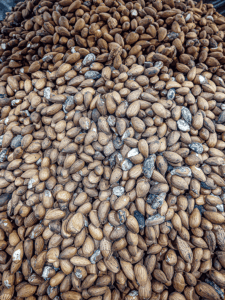
The first important consideration is understanding that moisture measurement is not a precise science. The reading obtained by any meter is only as good as the sample being measured, and moisture levels can vary significantly within any lot of almonds. Second, “green nuts are not the same as wet nuts.” The difference there requires different handling procedures. Machado said green means nuts are immature and not ready for harvest.
“You are not trying to dry an immature almond, you are trying to mature it,” Machado said. The moisture in a green nut is different and the drying process can take twice as long to reduce the moisture in a green almond kernel than it does to dry a wet almond with the same measured moisture level.
The basic rule for decisions about harvest timing when wet weather is forecast is to leave the nuts on the tree as long as practical.
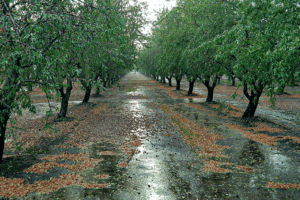
“Don’t put wet or green nuts on wet ground,” Machado said. If the nuts are on the ground, he advises not to sweep them into a windrow right away, even if you are able. Sweeping wet nuts onto wet soil will not help them dry, he added.
At some point, nuts will have to be swept into a windrow, but enough time should be allowed for the floor to dry, at least so the nuts don’t stick to the soil. Machado said the best choice would be to condition the windrow when possible to promote the best drying in the field.
“Don’t put wet or green nuts on wet ground.” — Mel Machado
Michael Roots, field outreach manager with the Almond Board of California, said the more spread out the almonds are, the better drying will be. If an opening pass has been done, it is best to wait and do closing passes into a windrow until the nuts have dried out again.
Roots said hull moisture is a big factor in harvest after a rain event or when floors are damp. Often, the kernels will be at an acceptable moisture level, but the hulls will soak up moisture exceeding the level that is acceptable at the huller. He emphasized that communication with the huller and making sure the nuts are at an acceptable moisture level is crucial. Sending in hulls that are too wet can cause major issues beginning with unloading and continuing all the way through the hulling and shelling process.
Proper handling starts in the orchard
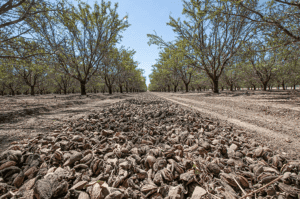
Conditions vary, and so do the appropriate actions to take when dealing with a wet crop. If the almonds have been shaken, more than likely the best place for them is flat on the orchard floor. Almonds in a windrow with soil and leaves will not dry and microbial activity will cause the temperature in the windrows to increase high enough to critically impact nut quality. Removing the soil and debris from the windrow will promote drying and protect the quality of the crop. Machado noted that if a conditioner is not available, an old-style trailer with doors on the bottom will work. Pulling it behind the harvester and channeling the nuts back into a more compact area makes sweeping when the actual harvest takes place a bit easier. The key is to have only clean in-hull almonds on the ground, not mixed with soil and leaves.
When the windrow is too wet or heavy to run through a pickup machine, it can be mechanically “stirred.” Machado said he has growers who sweep windrows to turn them over or use spring tines on a toolbar to break the windrow open.
When it comes to “wet” nuts, there are other considerations for harvest and handling. Those include variety, soil type, tree age and size, and the stage of harvest, including whether the nuts are on the tree or on the ground in a windrow.
Machado said soil type and the amount of rain received will dictate when harvest equipment can be sent into the orchard. The short-term weather forecast will also have to be considered when making harvest decisions.
Variety and orchard age and size are also considerations with a rain-challenged harvest. Monterey almonds have a thick hull that acts as a sponge and is slow to dry. Independence has a longer bloom time resulting in a range of maturity.
Older or large trees may have canopies that block light from the orchard floor. East-west rows will dry slower than north-south rows as the east-west orientation leaves the south side of the orchard “middles,” where the nuts lie in shadow during late summer and early fall. Machado said nuts on the south side will need to be swept out into the middles to “see” the sun. Another option for growers with the capability is to pick up the crop and spread it on open ground to dry.
The goal is to promote drying in the orchard and to bring the driest portion of the crop to the huller first. This practice will provide the highest daily throughput. Product arriving at 8% moisture will need three to five hours on the drier. Nuts at 18% will need more than 24 hours. Green nuts will take even longer.
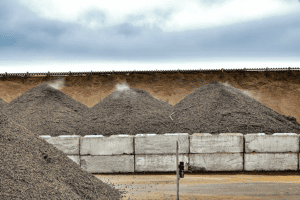
Machado’s hard-and-fast rule about handling high-moisture almonds is that once you pick them up, you must keep them in motion. They must not be allowed to sit in a trailer or stockpile for any length of time as microbial activity will create heat, literally destroying the kernel. Communication between the grower, harvester, huller/sheller and handler is critical.
Kevin Long, general manager at Mintun Nut Cooperative in Le Grand, said rains and other factors in 2025 had a significant effect on crop turnout. After a dry summer, turnout was 21% to 22% due to heavier hull weight. The thick hulls, plus the wet weather, made it even tougher to achieve a low moisture level when arriving at the huller.
“It’s a dilemma for growers, to shake or leave on the tree,” Long said.
About a third of growers stockpile their nuts on-site, and Long said Minturn pays an incentive for stockpiling.
Last year, he said one grower with a late pollinator crop, who had the area and the resources, piled the nuts temporarily and covered them until after the rain passed, then spread them out to dry, which helped significantly improve quality.
Growers should closely monitor weather for the best drying opportunities and make good decisions with their crop.
Publisher’s Take
The Big Picture: What to do Next
1. Leave nuts on the tree when practical
When rain is forecast, avoid putting wet or immature nuts onto wet orchard floors if harvest timing allows.
2. Let the orchard floor dry
If almonds are already down, keep them spread out until the floor has dried enough that nuts will not stick to the soil before sweeping into windrows.
3. Promote airflow through wet windrows
Condition or mechanically open wet, heavy windrows and remove soil and leaf debris to improve drying and protect nut quality.
4. Check moisture before hauling
Communicate with the huller and confirm both kernel and hull moisture are acceptable before sending the crop in.
5. Keep picked-up almonds moving
Do not allow high-moisture almonds to sit in trailers or stockpiles where microbial activity and heat can damage kernels.

Cecilia Parsons | Associate Editor
Cecilia Parsons has lived in the Central Valley community of Ducor since 1976, covering agriculture for numerous agricultural publications over the years. She has found and nurtured many wonderful and helpful contacts in the ag community, including the UCCE advisors, allowing for news coverage that focuses on the basics of food production.
She is always on the search for new ag topics that can help growers and processors in the San Joaquin Valley improve their bottom line.
In her free time, Cecilia rides her horse, Holly in ranch versatility shows and raises registered Shetland sheep which she exhibits at county and state fairs during the summer.