 TM
TM
Grade sheets from the processor or a third-party provide a valuable opportunity to make good management decisions that can improve the yield and quality of your walnut crop, leading to better returns.
The “report card” your walnut crop receives, whether from a huller-sheller or a third-party such as DFA, lets you know where you can improve management, and it influences a grower’s final payment for the crop, grower and processor/handler Brent Barton said.
The California Walnut Board said processor grade sheets are essential tools for growers and handlers, helping both understand the quality and marketability of individual lots of walnuts. Having accurate information during incoming inspections provides critical feedback to growers about cultural practices, but it is also the basis on which handlers determine the price for a grower’s walnuts. It is imperative that grading systems and sheets be accurate and trustworthy so growers can have a fact-based discussion with their handlers about their returns.
Learning from the Numbers
Barton serves as chair of the Walnut Board’s Production and Post Harvest Research Committee. He said growers should take the information in the grade sheet and learn from it, “see where you can do better.”
He confirmed that most growers do take their grade sheets seriously and act accordingly.
Grade sheets for walnuts list sizes and external defects to the hulls, including splits, broken and adhering hulls. Kernel color and defects are also listed, including blow, insect damage, rancid, mold and shrivel.
Brian Mori, director of field services at Crain Walnut, said grade sheets can indicate insect or disease damage and alert growers to damage trends in their orchards. Issues with insects or disease may be noted one year and, if not addressed, the problem can be compounded at the next harvest.
“Quality pays in the walnut market,” Mori said. Grade sheets from processors can be useful if the grower recognizes the issues. He noted that there are challenges as the walnut industry does not have a standard system in place and not all processors report product damage in the same manner.
He said the industry is working to mandate grade standards, but it is a multiyear process and technology is needed to improve accuracy and consistency.
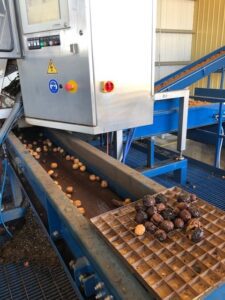
The California Walnut Board reports that its Grades and Standards Committee is working to modernize and standardize inbound inspections, with a focus on color and defects, using technologies that incorporate cameras and visualization software. The goal is to reduce inconsistencies from human inspections and ensure accurate, consistent grading. Several technology providers have worked with some handlers to test these systems, and the results are promising. The committee is working with DFA to establish guidelines and procedures to ensure proper equipment calibration and reliability so results are accurate and consistent on all incoming inspections.
Two Critical Areas
Barton recommends looking at two critical areas on the grade sheet: edible yield and color.
“Those two things have the biggest impact on what your payment will be.”
Edible yield, he said, is a function of two factors. The first is fill of the kernel as a percentage of the other parts of the entire shell contents. The second is a low defect percentage. Shriveled kernels will impact edible yields.
“If you neglect orchards, you will get skinny kernels and lots of defects,” Barton said. Grade sheets will reflect that.
He listed several management practices that can positively impact edible yield. Irrigation can have a major impact.
“If you get it right every time and keep trees adequately hydrated, maybe with timely, slight water stress through the growing season and postharvest, not overdoing the water, that will positively impact edible yield.”
Management Matters
Thoughtful pruning and tree nutrition can also play a part in reducing walnut kernel defects. Excessive canopy density causes nuts on the inside branches to produce shriveled kernels. Pruning to reduce walnut kernel defects focuses on managing light exposure and structural health. Too much pruning can leave some of the crop exposed to sunlight, which also causes shriveled and dark kernels.
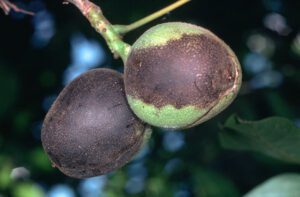
Kernel shriveling occurs as the sun transfers extreme heat inside the green hull, which stunts the developing nut and causes the kernel to shrink and shrivel. Sunburn damages the integrity of the walnut hull, making the nut susceptible to mold and fungal infections caused by Alternaria and Fusarium.
Defects often get their start in the spring, Barton said. Controlling blight and insect pests early can prevent mold and kernel shrivel.
One main key to preventing kernel defects is to harvest as early as possible.
“Once the nuts hit the ground, degradation of quality starts. Every day the nuts are on the ground after optimal harvest, you lose the opportunity for quality.”
Early harvest can also make up for earlier management errors in the orchard.
A Plan for the Future
Jaime Ott, UCCE advisor in Tehama, Shasta, Glenn and Butte counties, noted in the Sacramento Valley Walnut Newsletter that growers should consider how the 5% rule might apply in their orchard, where small improvements across multiple actions can yield large returns.
She advised growers to look at their grade sheets and pest and disease challenges to make a plan for the future.
Growers who are concerned about inadequate chill could explore dormancy-breaking treatments. Mating disruption to reduce navel orangeworm infestations and codling moth damage are also options for improving edible yield. Growers should also consider their sanitation efforts, understanding that any type of sanitation to reduce mummy nuts is better than none.
Routine maintenance on sprayers and irrigation systems can also be small improvements that contribute to a higher percentage of edible yield.
UC Davis plant scientist Barbara Blanco-Ulate writes that edible yield variability is a concern in California walnut production, particularly in mature Chandler orchards. The developmental and environmental factors contributing to the variability are not well defined, she added. Edible yield integrates multiple physiological processes across the hull, shell and kernel tissues throughout the growing season. An improved phenological context is needed to understand when and how differences in edible yield in orchards develop.
Publisher’s Take
The Big Picture: What to do Next
1. Review every grade sheet carefully
Grade sheets are more than payment documents; they identify management practices that can improve future returns.
2. Focus on edible yield and color
These two factors have the greatest influence on walnut payments.
3. Irrigation affects kernel quality
Proper water management throughout the season and postharvest can improve edible yield and reduce defects.
4. Harvest timing is critical
Every day walnuts remain on the orchard floor after optimal harvest can reduce quality.
5. Small improvements add up
Better sanitation, equipment maintenance, pest control and dormancy management can collectively increase edible yield.

Cecilia Parsons | Associate Editor
Cecilia Parsons has lived in the Central Valley community of Ducor since 1976, covering agriculture for numerous agricultural publications over the years. She has found and nurtured many wonderful and helpful contacts in the ag community, including the UCCE advisors, allowing for news coverage that focuses on the basics of food production.
She is always on the search for new ag topics that can help growers and processors in the San Joaquin Valley improve their bottom line.
In her free time, Cecilia rides her horse, Holly in ranch versatility shows and raises registered Shetland sheep which she exhibits at county and state fairs during the summer.