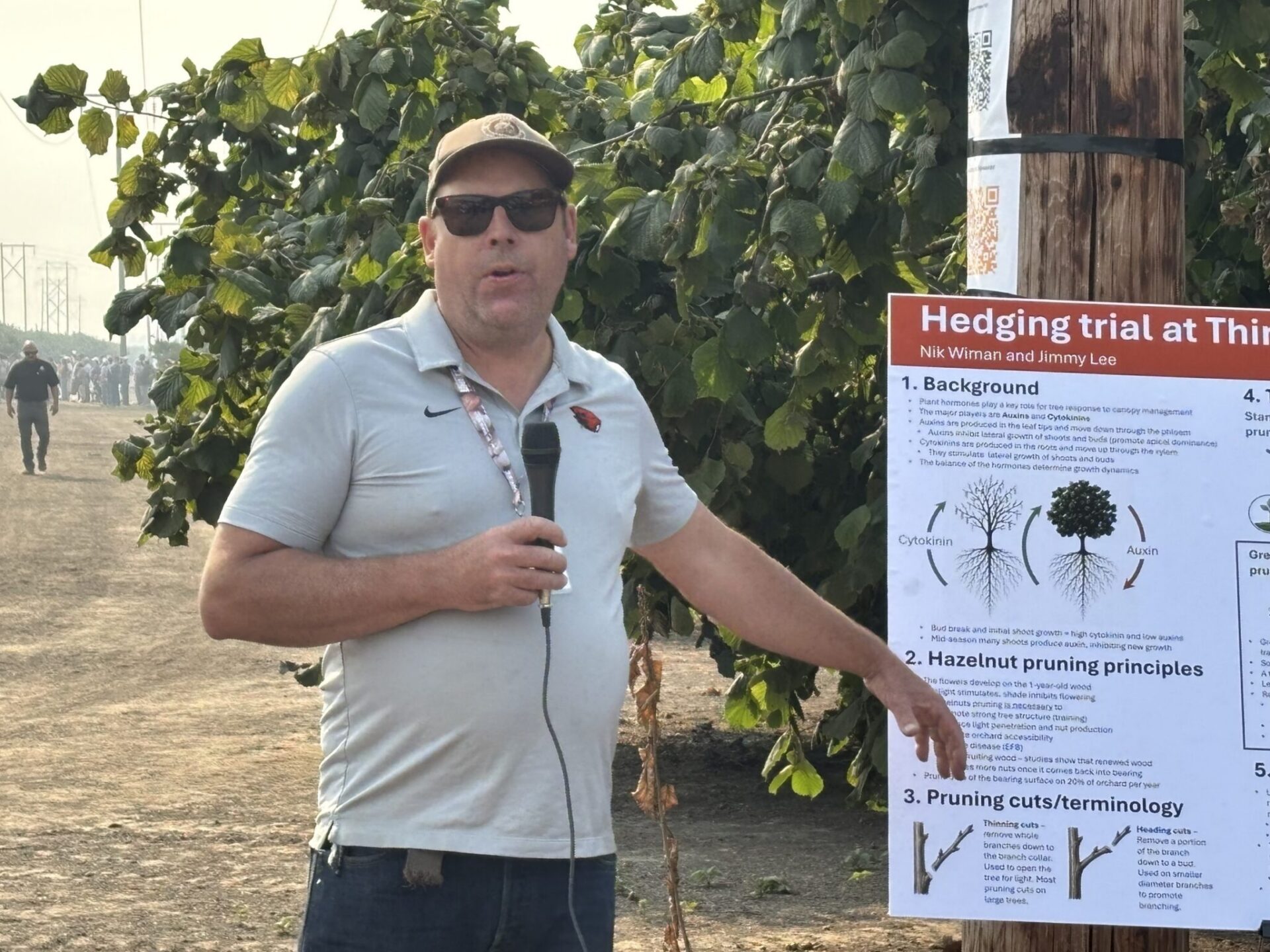
Unlike some other tree nuts, hazelnut trees require aggressive pruning to reach their full potential, according to a presentation at the Nut Growers Society Summer Tour, Aug. 5 in Albany, Ore.
“I know probably a lot of you have seen the articles in magazines about long-term pruning studies in California nut crops where they find not doing anything is just as productive as heavily pruning,” said Oregon State University Extension Orchard Crops Specialist Nik Wiman. “But I think we have a different situation in hazelnuts where we really need to be pruning and renewing wood.”
Trees that are well pruned are more resistant to bud rot, a fungal disease that attacks buds, catkins, leaves and husks, Wiman said, and have more vigorous growth. “I can’t tell you how many orchards I have encountered where production has stalled out or the trees just don’t look good and some heavy pruning can really help rejuvenate that canopy,” he said.
Twenty Percent
In general, growers should prune or hedge bearing wood on 20 percent of an orchard per year, according to OSU guidelines. Wiman noted that the two main types of pruning promote different results: thinning cuts, where a grower is removing whole branches down to the collar, can open up a canopy; heading cuts, where a grower is removing part of the branch up to a bud, promote branching.
Pruning at different times also promotes different results: winter pruning can trigger vigorous growth, he said, while summer pruning can be used to help control vigor. “So, in situations where we are trying to keep trees smaller, we’re pruning with the leaves on … so suppressing the growth of the buds,” he said.
When hedging, spring timing is ideal, Wiman said. Although hedging can lead to the loss of nut clusters that fall to the orchard floor, it can help improve nut fill in that year’s crop and improve the following year’s crop.
“I understand it hurts,” Wiman said, “especially with good nut prices right now. But you’re doing the same thing in the winter. It’s just not as apparent. You’re removing fruiting wood when you’re pruning in the winter. It’s just the nut clusters aren’t as developed. So, for some reason, it’s more emotional when you actually see those clusters on the ground.”
Wiman said concerns about diseases moving into trees through hedging cuts, which are less precise than thinning cuts, have not manifested. “We really haven’t seen that,” he said. “It often doesn’t look amazing, because you might see some shatter on the tip of a branch, but so far, I haven’t seen any issues from that.”
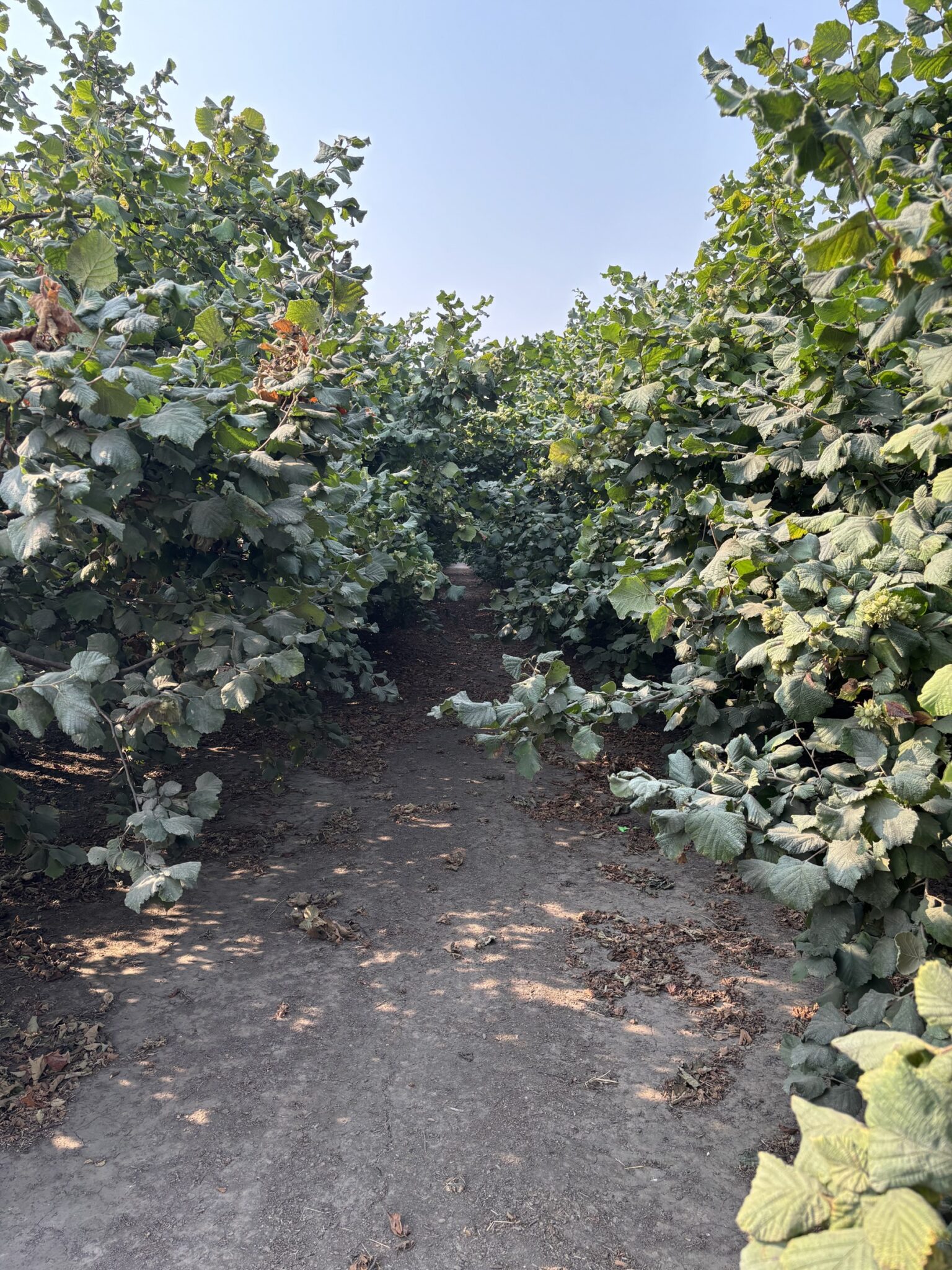
Rotational Hedging
Rotational hedging, where a grower hedges the west side one year, the east side one year, the north side one year and then the south side, can be an effective means of pruning 20 percent of your orchard’s bearing wood per year, Wiman said. He added that growers might consider using different hedging angles, noting that certain cuts may help improve sunlight interception. In a trial now in its third year, Wiman is comparing standard vertical hedging cuts to those made at a 30-degree angle, similar to a Christmas tree shape, to see if that might improve sunlight interception in a tree.
“So far, we haven’t seen much of a difference between the treatments,” he said. “For the angle cuts we had a little bit less production the first year we measured it. I think that’s because we took off more wood. But now in the second year, the angle cuts were much closer numerically to the pure vertical hedge and I do think that this year, they might eclipse the other treatments.”
Enhanced light penetration, an important factor in nut production, and improved orchard accessibility are two benefits that heavy pruning or hedging can bring to an orchard, Wiman said.
Heavy pruning or hedging also can strengthen tree structure, helping avoid limb breakage in ice storms, such as the ones that hit the Willamette Valley in 2021 and 2025. “So, we need to be promoting strong trees, strong growth,” Wiman said.
Heavy pruning or hedging can also help slow the penetration of Eastern Filbert Blight (EFB) in orchards. “A lot of growers have implemented successful Eastern Filbert Blight management programs through hedging out diseased wood and letting it renew,” Wiman said.
Wiman acknowledged that it can be unsettling to prune out infected material on some of the smaller trees in production today, such as Yamhill, but it is often necessary for tree health.
“We had a lot of big trees back when Eastern Filbert Blight first came into the area, and there is room to cut on those,” Wiman said. “When we’re seeing these infections on the newer orchards, it is devastating, because there’s not much tree left when you get to cutting the cankers out of the tree.”
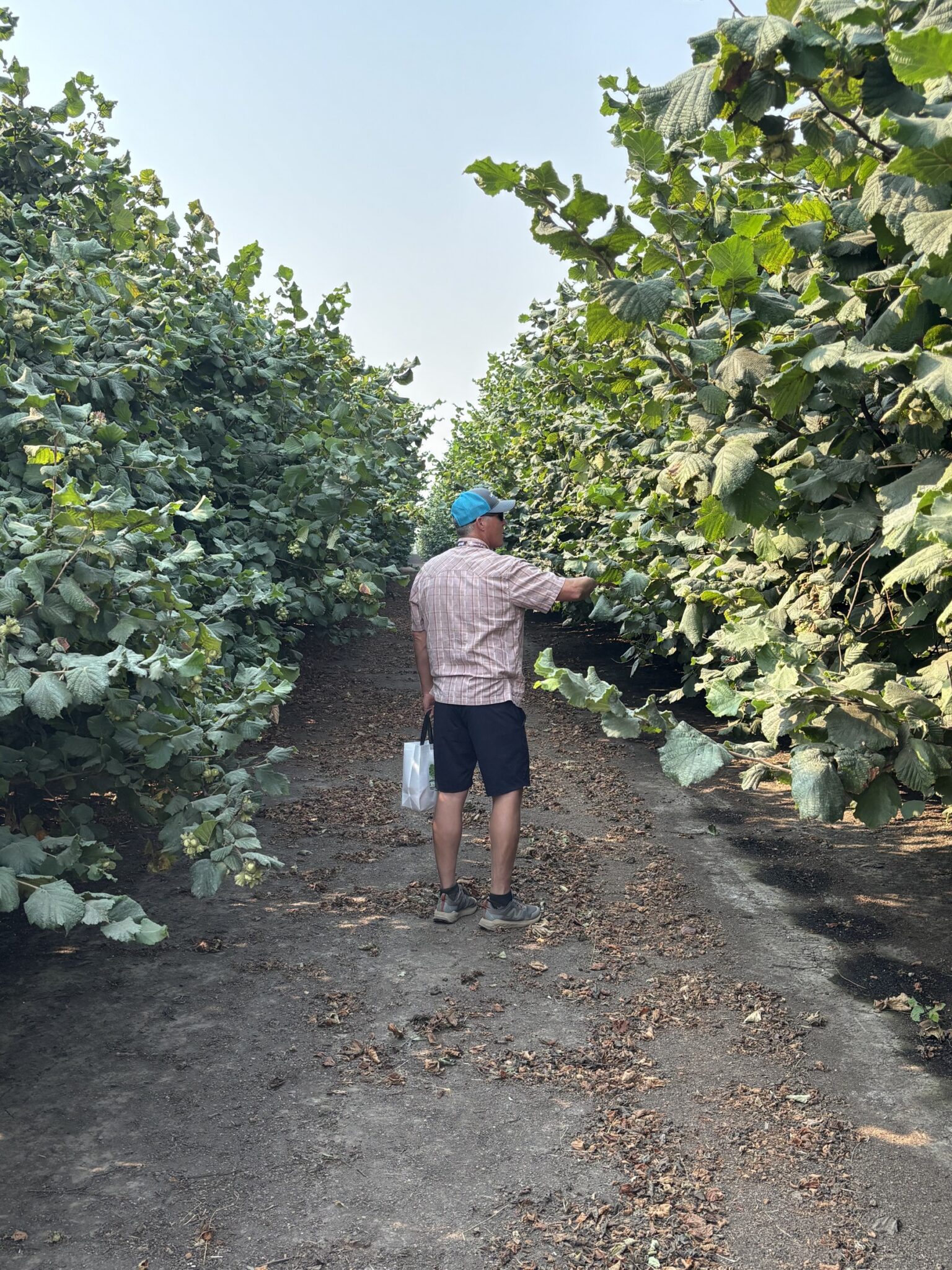
In general, research is showing that trees that are aggressively pruned or hedged are performing as well or better than those not hedged.
“So, what this tells me is that you can hedge (aggressively) without hurting yields at all,” Wiman said. “And I think probably for Yamhill, particularly, it is such a big crop that at times, the tree has a hard time finishing off all of those nuts.
“And of course it looks a lot better in the hedgerows and the orchard is very accessible, so I really think that we can get a lot more aggressive and take out more of the tree,” he said.
Originally published in the October / November 2026 issue of West Coast Nut, beginning on page 50.
From the Orchard
to Your Next Good Decision.