 TM
TM
Rain events during the 2025 harvest were blamed for higher percentages of mold in the walnut crop. Kearney-based UC Plant Pathologist Themis Michailides said mold percentages have been trending higher in the past several years.
“It has been an issue at hullers for the last ten years. We want a less than two percent level,” Michailides said. He listed higher humidity levels in more closely planted orchards and less isolation from other walnut orchards as probable causes for an increase in moldy kernels.
Mold severely reduces walnut kernel quality. It causes visible discoloration, white or gray fuzzy growth and black or bluish spores. It creates a bitter, rancid taste, breaks down healthy oils and can lead to commercial downgrading or complete crop rejection.
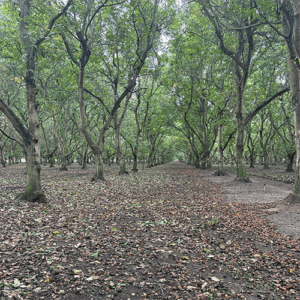
In 2020, processor grade sheets showed 5% to 6% mold, with 10% to 16% mold levels in orchards close to the Sacramento River in Butte County.
In 2021, Tulare County had 21% mold in Chandler walnuts. In 2022, 2023 and 2024, mold levels were 5%, 7% and 9%, respectively, in Tulare County. Last year, in Chandler walnuts in Tulare County, the mold level reached 27% following the September and October rains.
Isolations from blighted, black and moldy nuts, peduncles and spurs collected in six Chandler orchards following rains in September and October 2025 showed orchard No. 1 with 67% of kernels infected with Fusarium and 17% infected with Alternaria. In orchard No. 2, 87% of blighted peduncles were infected with Fusarium and 7% were infected by Botryosphaeria (Bot). The highest infection level of Bot was in orchard No. 2, with 12.5% of kernels.
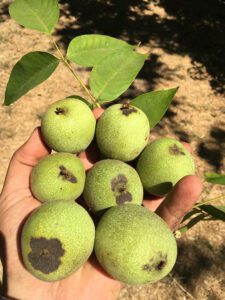
Michailides’s Walnut Board-funded research has shown that most walnut mold develops from Fusarium and Alternaria species. Where Bot canker and blight disease is prevalent in an orchard, the causes of mold will be Bot, followed by Aspergillus niger, Alternaria and Fusarium. Known conditions that compromise the integrity of the walnut hull, including walnut blight, sunburn or insect damage, all serve as entry points for mold fungi.
Infections in blighted, black moldy nuts caused by Fusarium and Alternaria will stop at the interface of the peduncle and spur. However, in blighted nuts infected with Bot, the infection continues to kill the spur. Research into all causes of mold continues.
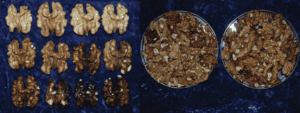
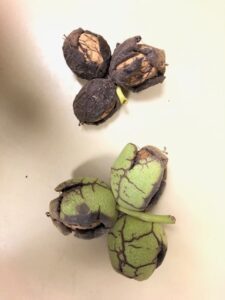
Mold is also considered a damage category under U.S. walnut grade standards (Photo courtesy of Frank Alves.)
Development begins
Walnut mold does not begin to develop until the hull completes maturity and begins to split. This means walnut mold spray timing is later than Bot prevention spray timing. A fungicide program for Bot will reduce mold to some degree, but pre- and early hull-split sprays may be needed to control mold. The UC publication Sac Valley Orchards reports that, depending on the time of infection, nuts show different symptoms. Infections at bloom, when the mold develops sooner, result in brownish, wrinkled and intact hulls. Nuts infected at early hull split will have cracked or partially split hulls. Nuts infected at the later hull-split stage will have black hulls and entirely split hulls. More mold was found in the earlier-infected nuts than the later-infected nuts.
According to UC research, walnut blight that does not penetrate the kernel or cause nut drop can still create an entry for mold caused by Fusarium and Alternaria species. These infections are a specific type of walnut mold called brown apical necrosis. The fungal infection spreads to the kernel from the apical (stylar) end. Maintaining hull integrity can also help manage walnut mold. Higher incidence of mold has also been noted in sunburned nuts, nuts infested by insects and windfalls.
Picking up the same day as shaking has been shown to be a critical practice for reducing mold and maintaining overall quality.
Blighted, black nuts delivered to the huller contribute to higher mold levels. Michailides noted that a walnut crop delivered to a huller was found to have 27% mold. When blighted, black nuts were removed, the mold-infected percentage was reduced to 4.4%.
Quality effects
From a quality and marketing standpoint, the presence of mold on walnut kernels can affect both domestic and export sales. Thomas Jones with Safe Food Alliance said visible mold makes the product less desirable and can also signal the presence of potentially toxic mycotoxins. This impacts the value of the product.
According to U.S. Standards for Grades of Walnuts in the Shell, mold is listed as one of seven categories of walnut damage: broken shells, perforated shells, adhering hulls, discoloration (stain), mold, shriveling and insect damage.
Mold is considered damage when attached to the kernel and conspicuous, or when inconspicuous white or gray mold affects an aggregate area larger than 1 square centimeter or one-eighth of the entire surface of the kernel.
Management
Cultural practices that can lessen mold infections include avoiding standing water in the orchard to decrease humidity. Alternaria and Fusarium are airborne fungi, and reducing dust during bloom and hull split also reduces the inoculum that can infect flowers and hull-split nuts.
Treatment options
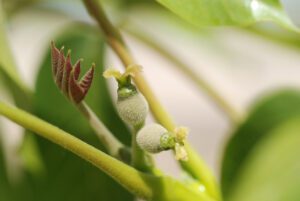
Fungal pathogens have been identified on walnut flower stigmata. Michailides said fungicide treatment at bloom resulted in only 10% infections, while nonspray controls had 34% fungal infections.
“This led us to think about applying fungicide sprays at bloom and/or before hull split to early hull split to reduce mold,” he said.
Michailides cited several fungicide trial sprays that were effective. A single spray with flutriafol (Rhyme) at a rate of 7 fl oz. per acre one to three weeks before hull split or at 20% to 30% hull split resulted in a 60% to 70% reduction of mold in a Chandler orchard in Butte County.
In a sprinkler-irrigated Chandler orchard with heavy Botryosphaeria canker and blight pressure, one bloom spray with Merivon, Cevya or Luna Experience reduced moldy nuts by 43% to 73%.
Other trial results can be found in Sac Valley Orchards under mold management.
Michailides noted that doing a better job removing blighted “black” nuts at the huller will reduce the incidence of scorable mold in walnuts.
He noted that one fungicide at bloom or at the hull-split stage is sufficient to reduce black moldy nuts caused by Bot/Phomopsis or moldy nuts caused by Fusarium and Alternaria fungi.
Finally, one late-September fungicide spray using Merivon (FRAC 3/11), Fontelis (FRAC 7), Luna Experience (FRAC 3/7) or tebuconazole (FRAC 3) reduced blighted “black” moldy nuts by 50%.
Publisher’s Take
The Big Picture: What to do Next
1. Keep orchard humidity down
Avoid standing water where possible to reduce conditions that favor mold development.
2. Cut dust at critical timings
Reduce dust during bloom and hull split to limit airborne Alternaria and Fusarium inoculum.
3. Protect the hull
Manage walnut blight, sunburn and insect damage that can create entry points for mold fungi.
4. Get nuts off the ground quickly
Pick up walnuts the same day as shaking when possible, to reduce mold and protect overall quality.
5. Review fungicide timing with your PCA
Consider orchard disease pressure and UC trial results when evaluating bloom and hull-split fungicide applications.

Cecilia Parsons | Associate Editor
Cecilia Parsons has lived in the Central Valley community of Ducor since 1976, covering agriculture for numerous agricultural publications over the years. She has found and nurtured many wonderful and helpful contacts in the ag community, including the UCCE advisors, allowing for news coverage that focuses on the basics of food production.
She is always on the search for new ag topics that can help growers and processors in the San Joaquin Valley improve their bottom line.
In her free time, Cecilia rides her horse, Holly in ranch versatility shows and raises registered Shetland sheep which she exhibits at county and state fairs during the summer.