 TM
TM
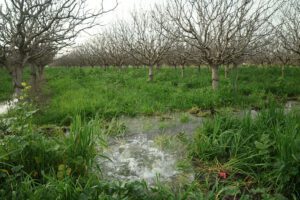
On-farm groundwater recharge isn’t a new practice, but a collaborative effort is growing the understanding of where recharge works, how to manage it and how soil health practices can improve outcomes.
More importantly, a multi-year study in San Joaquin Valley pistachio orchards will provide growers with actionable tools to build orchard resiliency under SGMA, Joe Coelho, American Pistachio Growers (APG), director of sustainability, said.
With a Specialty Crop Block Grant, Sustainable Conservation has teamed up with APG, Fresno State University and six pistachio growers in Madera and Tulare counties to carry out this groundwater recharge study.
Intentional on-farm groundwater recharge has previously been carried out in California almond orchards and vineyards. Where excess surface water and conveyance are available, adoption of the practice has continued to grow. Capturing the extra surface water and channeling it to farm ground to percolate into the groundwater aquifer has been identified as a promising approach to support groundwater sustainability.
The Soil Agricultural Groundwater Banking Index (SAGBI) is a suitability index for groundwater recharge on agricultural land. This publicly available map tool developed by UC Davis researchers shows the suitability of sites for groundwater recharge. The index is based on five major factors that are critical to successful agricultural groundwater banking: deep percolation, root zone residence time, topography, chemical limitations and soil surface.
Cover Crops and Soil Health Under Evaluation
The partnership between APG and Sustainable Conservation began about three years ago with a clear objective, to move on-farm recharge from concept to practical application in pistachio systems, while also advancing the soil health practices that influence how effectively recharge can occur.
The combination of groundwater recharge and cover crops are being studied to better understand how soil health practices can improve groundwater recharge outcomes, including potential leaching of nitrogen from soils, which may impact water quality. By directly comparing recharge on cover-cropped and bare ground pistachio orchards, the partnership aims to clarify how groundwater recharge can be scaled in ways that support water supply, water quality and soil health.
Fresno State plant sciences professor Sangeeta Bansal and her team of graduate students are leading the scientific research.
Instrumentation installed at multiple depths tracks soil moisture and collects soil pore water for nitrate analysis in both cover-cropped and bare ground blocks, while soil sampling through the rooting zone helps capture changes in soil nitrate, salinity and other soil health indicators over time.
Sarah Castle, senior scientist with Sustainable Conservation, said that the pilot study is evaluating how recharge performs in working orchard conditions, across different soils and management approaches. The study is also examining how planted cover crops influence the groundwater recharge outcomes related to water infiltration and nutrient retention. The three-year study will continue through June 2027.
Grower Participation Provides Real-World Insights
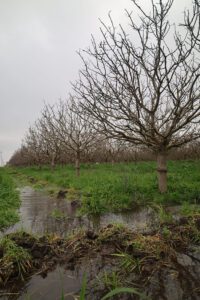
Farmers participating in the study have already conducted recharge across more than 200 acres of pistachio orchards. Half have cover crops planted while the other orchards allow native vegetation to grow or manage for bare floors.
“We will be looking closely at soil health in orchards, focusing on the benefits of planted cover crops,” Castle said.
Castle said the study will help growers understand what practices measurably improve soil health in orchards and the effects of groundwater recharge on tree health. He said infiltration rates are also being compared in cover crop orchards to bare floor orchards. Surface water for recharge was delivered by irrigation districts. Growers applied from 1 to 3 acre-feet in the most recent recharge trial. Tulare area pistachio grower Philip Cunha has 40 acres of mature pistachio trees in the study, half of which have cover crops planted.
Last year was his first for planting cover crops in his pistachio orchard. In preparation for the study, he planted cover crop mixes that included legumes, grasses, clover and safflower. His orchards were originally flood irrigated. In 2014, a drip system was installed, but the original setup allowed him to move the recharge water in. He applied one acre-foot per acre in the trial.
Cunha said mapping showed his orchards were acceptable sites for recharge and he observed infiltration rates were best in the cover crop orchard.
Fresno State’s Bansal and her team of graduate students are providing scientific research, taking a close look at infiltration rates, nitrate leaching and soil biology.
Instrumentation installed at multiple orchard floor depths tracks soil moisture and collects soil pore water for nitrate analysis in both cover-cropped and bare blocks, while soil sampling through the rooting zone helps capture changes in soil nitrate, salinity and other soil health indicators over time.
“If we can help growers secure
their water supply and remain
productive that’s the foundation.” – Joe Coelho, director of sustainability, American Pistachio Growers.
Bansal said preliminary data on infiltration are confirming Cunha’s observations.
“These pilots are designed to evaluate how recharge performs under real orchard conditions, across different soils and management approaches, with a focus on both water infiltration and the short- and long-term impacts to orchard productivity,” Bansal said.
She said the findings suggest planted cover crops help hold nitrogen in the root zone during recharge events, preventing leaching below the root zone where groundwater quality could be affected.
The study will also be collecting data on crop yields, she noted. After two years, she said no negative effects were being observed by growers.
California Water Institute at Fresno State is also playing a part in the study, supporting outreach and training opportunities for growers and technical assistance providers.
Coelho reports that a key outcome of this study is the development of an on-farm recharge manual tailored specifically for pistachio production. The manual will be available to APG members and the broader industry. He said the partnership has placed a strong emphasis on education and outreach. As the study progresses, APG has hosted multiple water and soil health education days, developed video content and created supporting materials to help growers understand not just how to implement recharge in their orchards, but how it fits into the broader system.
Coelho said from APG’s perspective, this partnership is a model for how to approach sustainability in a way that is grounded in real operations.
“If we can help growers secure their water supply and remain productive that’s the foundation. The environmental benefits, groundwater replenishment, improved soil function and long-term system resilience follow from there in a way that is both practical and scalable.”
Publisher’s Take
The Big Picture: What to do Next
- Use SAGBI to Evaluate Suitability
The Soil Agricultural Groundwater Banking Index (SAGBI) helps determine whether
orchard land is suitable for on-farm recharge. - Cover Crops Can Improve Recharge Outcomes
Planted cover crops may increase infiltration rates and help retain nitrogen in the root zone, reducing the risk of groundwater contamination. - Recharge Volumes Are Manageable
Growers in the study successfully applied 1 to 3 acre-feet of water per acre, demonstrating practical implementation under real orchard conditions. - No Negative Yield Impacts Observed
After two years, participating growers reported no adverse effects on tree health or productivity. - Educational Resources Are Forthcoming
An on-farm recharge manual tailored to pistachio production will provide step-by-step guidance for growers.

Cecilia Parsons | Associate Editor
Cecilia Parsons has lived in the Central Valley community of Ducor since 1976, covering agriculture for numerous agricultural publications over the years. She has found and nurtured many wonderful and helpful contacts in the ag community, including the UCCE advisors, allowing for news coverage that focuses on the basics of food production.
She is always on the search for new ag topics that can help growers and processors in the San Joaquin Valley improve their bottom line.
In her free time, Cecilia rides her horse, Holly in ranch versatility shows and raises registered Shetland sheep which she exhibits at county and state fairs during the summer.