 TM
TM
Recent and ongoing trials at Nickels Soil Lab are changing some recommendations to prevent herbicide-induced trunk injury.
Ryan Hill, UCCE agronomy and weed science advisor in Tehama County, said recent results of this trial suggest that paint can protect the trunk surface from herbicide injury, but the effect is dependent on paint formulation. Hill said water stress also plays a role in instigation of trunk injury in tree crops.
David Doll, The Almond Doctor, notes in his blog that glufosinate herbicide use has increased over the past year. However, accidental applications of glufosinate to the trunks of newly planted to 3-year-old almond trees can cause damage. Herbicides harm young nut tree health by causing vascular girdling and foliar damage, resulting in stunted growth. The thin, green bark on young nut trees and their shallow root systems make them vulnerable to non-target chemical exposure compared to mature trees.
The health effects vary significantly depending on the type of herbicide used and the mechanism of exposure. Contact herbicides used in young orchards burn through to the cambium layer, girdling the tree and shutting off nutrient flow. Foliar drift causes chlorosis. In the long term, there can be depletion of stored carbohydrates, structurally weakened and smaller tree trunks, delayed first harvest, and vulnerability to pests and disease. Herbicide labels also carry a warning not to apply unless there is mature brown bark.
Nickels Trials Reveal Differences in Paint Protection
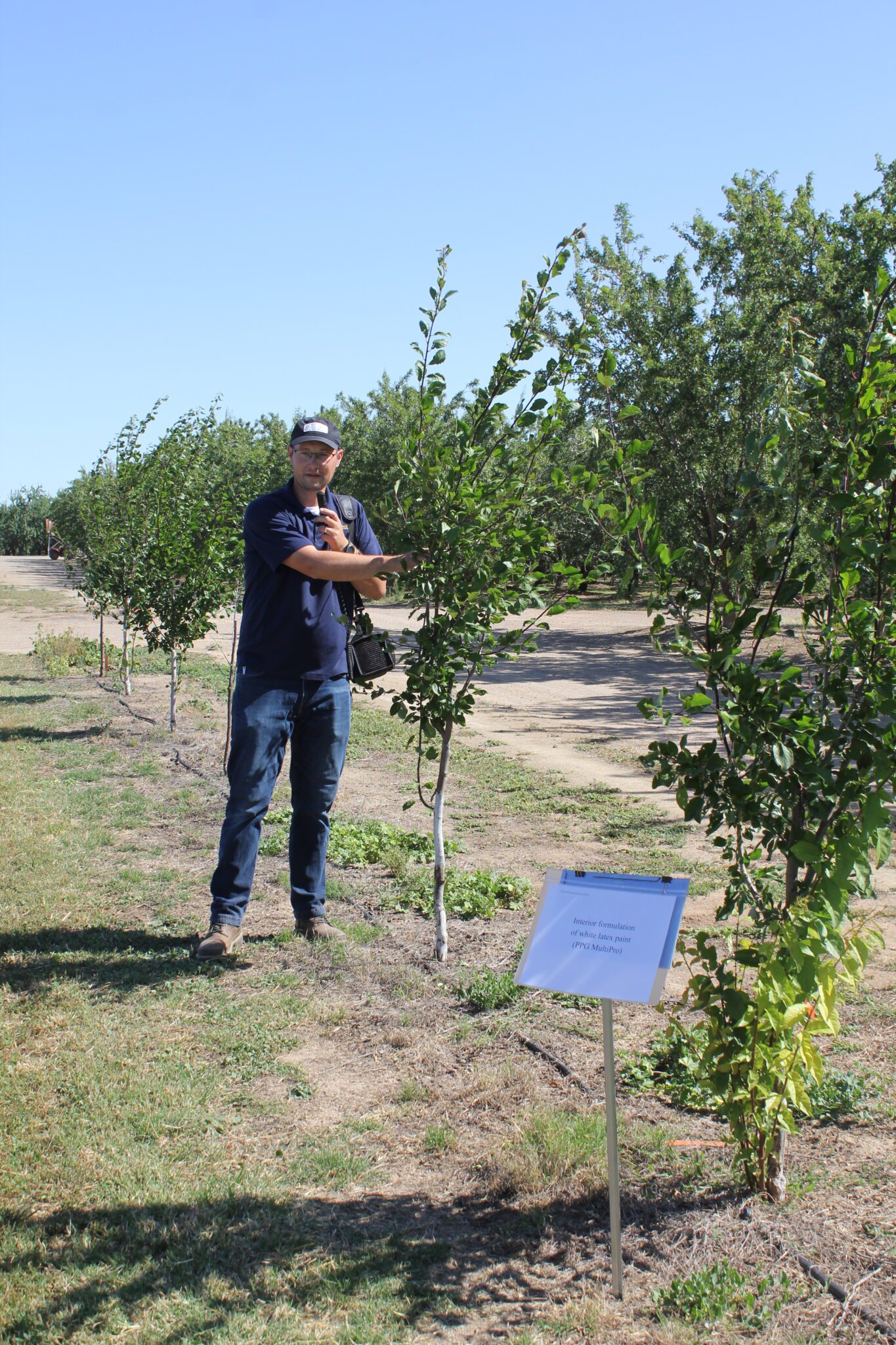
Hill noted at the Nickels Soil Lab Field Day in May that recent results of his herbicide injury trials there and in Red Bluff suggest that while paint can protect the trunk surface from herbicide injury, the effect is dependent on paint formulation.
Preliminary results from Hill’s paint protection trial at Nickels found that a single application of a glufosinate herbicide at three times the label rate on 5-month-planted trees killed 100% of the prune trees with bare trunks. It also killed 100% of the trees with trunks coated with exterior paint. Mortality was 50% among trees with trunks coated with interior paint. Trees had been in the ground five months and were at minus 18 bars at treatment. Potted trees are most sensitive.
Water Stress Increases Risk of Trunk Injury
At the Red Bluff trial with prunes, trees were stressed at minus 12 versus minus 13.7 on average at treatment, 14 months after planting. Two sequential treatments of glufosinate at three times the label rate were done. At minus 12 bars, 76% of the trees sustained injury.
Hill said in his trials that water stress made a difference in injury level from herbicides. He said he is looking closer at the water stress effects and how to reduce risk of tree injury.
Based on his trial results, Hill advised going with full-strength interior paint.
Cartons Provide Temporary Protection
Paper cartons commonly serve as a barrier to protect newly planted trees. While they can prevent direct spray contact with green bark during the first growing season, they will need to be removed at some point. Hill cautioned that leaving the cartons too long can also cause injury due to moisture buildup. Insects can also move inside and injure tree bark. Trees are vulnerable when the cartons are removed. Latex paint is usually applied at this time to further protect trunks from sunburn as well as herbicide injury.
Hill said paint applications on tree trunks remain a necessary protection. Unpainted trunks run the risk of sunburn, which also causes damage.
Application Timing Remains Important
Additional recommendations are to delay herbicide applications until the soil has settled and the bark has naturally aged and thickened. Application timing can also be managed by calibrating spray equipment to run at lower pressures to minimize fine mist particles.

Cecilia Parsons
Cecilia Parsons has lived in the Central Valley community of Ducor since 1976, covering agriculture for numerous agricultural publications over the years. She has found and nurtured many wonderful and helpful contacts in the ag community, including the UCCE advisors, allowing for news coverage that focuses on the basics of food production.
She is always on the search for new ag topics that can help growers and processors in the San Joaquin Valley improve their bottom line.
In her free time, Cecilia rides her horse, Holly in ranch versatility shows and raises registered Shetland sheep which she exhibits at county and state fairs during the summer.