 TM
TM
How growers are building stronger businesses through direct-to-consumer sales.
Farmers are innovators. They always have been. From George Washington Carver proving the importance of crop rotation to Benjamin Holt creating the first practical steam-driven tractor, farmers have long been known for taking risks and trying new things.
We started the From the Orchard feature more than two years ago, and in that time, we’ve talked to all sorts of innovators, growers looking at new ways to grow, harvest and market nuts.
Direct-to-consumer sales are one way that smaller growers are finding success through innovation, and several of our previous featured growers have shared how they approach this part of their business.
This month, instead of adding a new profile to the mix, we decided to look back at some of our previous interviews and revisit what those growers had to say about adding direct-to-consumer sales to their business models.
How did you get started with direct-to-consumer sales?
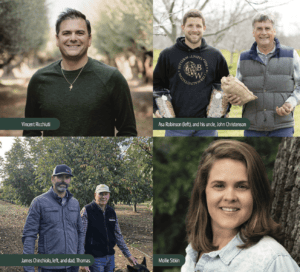
James Chinchiolo, Chinchiolo Farming Co.: Chinchiolo started direct-to-consumer sales with his cherry orchards and found early success.
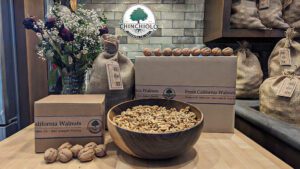
“Then I started the walnuts in a small way. I told my cherry customers, ‘Hey, click this button if you have interest in receiving information about our walnuts.’ And out of 10,000 people, about 300 people said yes. That’s not that many, but I got the same response as the cherries: ‘We can’t get these nuts anywhere. These are so great. They’re actually fresh.'”
Vincent Ricchiuti, P-R Farms: “We always had a small farm store, but things really took off when we launched the olive oil brand around 2011 or 2012. We rebranded to Enzo’s Table, named after my great-grandfather Vincenzo. The idea is that we’re selling things you’d find on his table. We mailed our first catalog around 2012 or 2013 and have grown steadily since then.”
Mollie Sitkin, Old Dog Ranch Family Farm: Sitkin recognized the value organic products could offer in a direct-to-consumer market.
“My dad always farmed with a regenerative idea in mind, but before I got involved, the farm was conventional. In 2012, I came to him and said, ‘I think we should think about direct-to-consumer products with just our walnuts.’ That’s where I was inspired. I did an MBA in sustainable business and thought, ‘This is actually special. Our quality and our farm are really unique.’ In 2012, we started our transition to organic, and we harvested our first organically certified walnut crop in 2015.”
Asa Robinson, Better Walnuts: “The market got really bad. The year we started, we pulled about 4,000 pounds, and on the rest of my uncle’s walnuts he was getting paid 19 cents a pound. When I found that out, I said, ‘Well, I’ll buy every one of his nuts right now for 19 cents a pound.’ At 19 cents a pound, you’re not risking much by taking them and trying to sell them yourself. So that’s why it grew. It was a huge amount of work, and I’ve scaled it back some since then.”
Diversification and direct-to-consumer sales are ways for a small farm to deal with that. — Asa Robinson, Better Walnuts
How do you appeal to consumers?
Mollie Sitkin: “How do you compete as a small business against industrial agriculture? It’s all about quality. It has to be. We want every time someone has our walnuts for the first time to say, ‘Wow, I’ve never had a walnut that tastes like this before.’
“We achieve that through really high-quality farming and taking care of the product after it comes out of the field. After compliance, quality is the No. 1 priority for us. We just try to make sure we have the best-quality product out there.”
Asa Robinson: “With our walnuts, they’re very consistent because they come from the same field, the same grower, the same sheller and the
same harvest. So when people buy them, they’re getting the same thing every time.”
James Chinchiolo: “It’s just very basic, in-shell walnuts and shelled. No flavoring, no nothing. Just the best walnuts we can provide.”
Vincent Ricchiuti: “Customers are buying directly from the farmer, so they know they’re getting something fresh and local. That’s been a big focus, growing that brand and staying vertically integrated all the way to the consumer. We’re using Nonpareil almonds in our almond butter, which is uncommon because of cost, but it’s delicious and has won awards.”
Customers are buying directly from the farmer, so they know they’re getting something fresh and local. — Vincent Ricchiuti, P-R Farms
What is your strategy for creating new products?
Vincent Ricchiuti: “We’ve added products that reflect what we grow. Our almond butter has three flavors: traditional, chocolate and autumn spice. The chocolate uses Guittard chocolate and our olive oil. The autumn spice is a seasonal product developed with Burlap & Barrel.
“Now we have an online store, a catalog business and retail stores. We’re also a big gifting company, especially in the fourth quarter. People receive our products as gifts and then become repeat customers. We handle our own packing and fulfillment, and it’s been a major area of growth.”
Mollie Sitkin: “I started with walnut milk. I really wanted to make a walnut milk product, but it was complicated. Food safety is significantly different for walnut milk than for seasoned walnuts and walnut butters, which is what we make now.
“The demand for walnut milk wasn’t as high, so the business evolved based on what customers wanted and the logistics of running the business. Now we offer a direct-to-consumer line with seasoned walnuts, raw walnuts, toasted walnuts and walnut butters.”
Asa Robinson: “Start small. Test things. The conditions forced us to go all in for a short time, but normally it makes sense to test whether something is viable before committing fully.”
What is the learning curve on direct sales?
Asa Robinson: “I really had to learn walnut marketing fast. I was on the phone and internet trying to figure things out and get walnuts sold. I learned Google Merchant Center, Google Search Console, Facebook ads, basically everything I could because I had to move product.”
Mollie Sitkin: “As a grower, all you have to do is get it out of the field. But as a seller of your own products, the most important thing is ensuring the consumer gets a fresh, amazing product. It makes harvest more stressful. A few years ago, a rainstorm before harvest affected our whole season. It’s tricky as a high-end walnut seller to have the farming operation tied to it, especially when there are factors out of your control.
“I think a lot of it I figured out on my own because there aren’t really a lot of people doing this. I haven’t really had a mentor. It’s been a lot of figuring things out.”
What challenges come with direct sales?
Mollie Sitkin: “We just need people to know that what we are doing is good. We’ve created a really healthy product, but as a small business, if you don’t get that word out, you’re not going to have a business.
“Honestly, with all of the pay-to-play marketing, I rely a lot on word of mouth. Our website grows every single year, and direct-to-consumer sales account for a little more than a quarter of our overall sales.
“That has developed through farmers markets that attract tourists who then go home and order online, and by communicating with people about what we’re doing.”
What are the benefits of a direct-to-consumer sales strategy?
James Chinchiolo: “I think about our own situation, and I have two boys who are 18 and 20. What I’m trying to do is develop a business that allows for a role for them that isn’t my role. Perhaps they end up taking over a marketing role that I developed for them.
“I think that’s personally a way to continue the family business. What I’ve observed locally is that the businesses that tend to attract family members back are the ones that are growing and creating roles similar to those outside of agriculture, where it’s not just the rugged farming piece.”
Asa Robinson: “I think the trend across a lot of ag industries is consolidation and thinner margins. Diversification and direct-to-consumer sales are ways for a small farm to deal with that.”
Vincent Ricchiuti: “Our family business is unique. We’re vertically integrated, and I’ve worked alongside my dad my entire career. My mom runs the retail store. Being able to work with both of them every day is special.”
Mollie Sitkin: “Taking a family farm that maybe needs a little help and changing it into more of a whole ecosystem is a fun piece of it. You can really see how things come together and feel pride in it.”