 TM
TM
In 1988, when Jay Pscheidt arrived at Oregon State University, Eastern Filbert Blight (EFB) was spreading largely unchecked in Oregon hazelnut orchards, and Pscheidt immediately was tasked with helping growers control the disease. One of his first acts was to take a second look at an EFB fungicide trial in Multnomah County that researchers had declared a failure.
“One of our county agents had deployed several fungicides in eight replicates, and the next year all the trees had cankers,” said Pscheidt, who retired June 30 as statewide Extension plant pathology specialist.
The county agent threw up his hands in frustration, but when Pscheidt visited the site, he had a different take. He noticed that the top-performing tree in six of the eight replicates had been treated with the same fungicide, giving hope that the product might hold promise.
The research he conducted to figure out the disease life cycle, fungicide efficacy and cultural controls really shaped the programs growers still use today to manage this challenging disease. – T.J. Hafner, agronomy manager, AgriCare, and vice president, Nut Growers Society
“I went around and said, ‘Okay, that tree looks the best in this replicate,’ and I looked on my map to see what was sprayed on it, and it was a product called Bravo. So I went to the second rep, did the same thing, went to the spray sheet and noticed that the tree in the best shape was also sprayed with Bravo.
“That data led to our first Section 18 for Bravo in 1990, and that was a nice thing that we could offer growers right away,” he said.
Concurrent with that discovery, research showed that bud break was the most important time to begin applying Bravo, providing growers with another key piece of information.
Finding a Better Way to Fight EFB
Researchers next set out to determine how many sprays were needed to control the disease and at what interval.
“We eventually found that four was a little better than three, but five just didn’t improve disease control, so that roughly translated to an eight-week infection period,” he said, with a two-week interval between applications.
Tough Sell
“And then you have to remember that back in the early ’90s, the price of the nuts was below 36 cents a pound, and trying to get growers to put those sprays on to protect future yield, well, that was a tough sell,” Pscheidt said.
After several years, however, growers could see that orchards treated with Bravo, or chlorothalonil, looked better than those that weren’t, and growers almost universally adopted the multi-spray approach to controlling the disease.
“We essentially were buying time until the (OSU Hazelnut) Breeding Program could develop resistant varieties a few decades later,” Pscheidt said.
Today, as Pscheidt heads into retirement, a new strain of EFB has overcome the resistance conferred by multiple cultivars now planted in the Willamette Valley. Meanwhile, the research Pscheidt conducted on the disease years ago is still shaping how the industry approaches EFB.
“The work Jay did on EFB management was absolutely critical to the hazelnut industry,” said T.J. Hafner, agronomy manager for AgriCare and vice president of the Nut Growers Society. “The research he conducted to figure out the disease life cycle, fungicide efficacy and cultural controls really shaped the programs growers still use today to manage this challenging disease.”
Shaun George, COO of George Packing, said Pscheidt’s contributions to the hazelnut industry extend beyond the farm to helping marketers and packers.
“As a hazelnut marketer and packer, we could always count on Jay Pscheidt to help us identify diseases and find solutions for our Pacific Northwest farmers,” George said. “He didn’t just manage diseases, he empowered growers with tools, knowledge and hope.”
George recalled an incident in 2016 when the industry encountered a major mold problem.
“Jay identified the problem, so I could go to China and smooth it over with the buyers. I showed them that it was just a one-off issue, that it was not an ongoing issue. And I had evidence from Jay to kind of prove that,” George said.
“Jay was just a very helpful guy. When we had trouble, he was always there.”
One Foot in the Furrow
Pscheidt, who had no particular connection to farming when he entered college, brought a philosophy to his work that he developed while attending the University of Wisconsin-Madison, where he earned a bachelor’s degree in bacteriology and master’s and doctoral degrees in plant pathology.
“The saying at the University of Wisconsin was, ‘Keep one foot in the furrow,’ just always make sure that you are ground-based,” Pscheidt said. “And I’ve always tried to do that.”
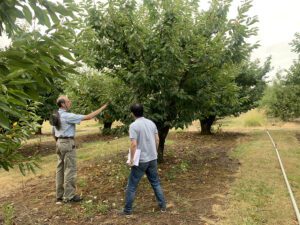
At OSU, Pscheidt regularly visited farms to help growers address issues, something he much preferred to discussing problems over the telephone.
“It is so much easier when you can visit the orchard, look and see what is going on, and not just look at the tops of trees, but educate people that you’ve got to look at what’s going on underground as well,” he said.
“Jay was the best detective I have ever encountered in going out to an orchard and trying to determine the cause of a dying or dead tree,” said OSU Extension orchard specialist Nik Wiman.
“He had a systematic, scientific approach on the level of Sherlock Holmes to figure out what was wrong. And he knew not to make assumptions or jump to conclusions. He was an important mentor to me as I started my job.”
Wiman added that Pscheidt’s departure “leaves a big hole in the industry.”
“I hope OSU does everything possible to refill his position as quickly as possible given all the new disease challenges in the hazelnut industry,” Wiman said.
When visiting farms, Pscheidt said he would initially look at a problem through the growers’ eyes and, after identifying what was wrong, try to get the growers to see the problem through his eyes.
He always based management recommendations on practical solutions.
“Always, always, it has to be what we can take off the shelf today,” he said. “What can we physically do today or in the next couple of months or this next season? None of this, ‘Oh, in 10 or 20 years you might have this option.’ We don’t do that sort of stuff. That doesn’t fly well, because they’ve got to pay the banker today or tomorrow.”
Teaching Beyond the Research
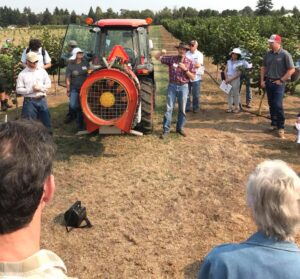
Pscheidt also spoke regularly at field days and grower meetings, bringing an enthusiasm to his presentations that captured audiences. But it wasn’t always that way. Early in his career, he often felt frustrated when audiences weren’t paying attention to his research reports. He said a colleague encouraged him to change his approach.
“I can’t remember exactly who it was that said, ‘Jay, look at it a different way. Here’s your half hour. It’s your challenge to get their attention and get something across to them.’ And that really stuck with me.
“I’m like, ‘Okay, it’s up to me to grab that attention. I’ve got the podium. Let’s make use of it. Don’t give just a dry, boring speech. How can I switch it up so that it makes it interesting to somebody out there?'”
We could always count on Jay Pscheidt to help us identify diseases and find solutions for our Pacific Northwest farmers. He didn’t just manage diseases, he empowered growers with tools, knowledge and hope. – Shaun George, COO, George Packing
Pscheidt, who worked with multiple crops during his tenure at OSU, estimated he spent 20% of his time on hazelnuts. Today, as he transitions to a 10% workload, he will spend all of his remaining time on hazelnuts, wrapping up EFB fungicide trials, particularly research on fungicide drenches, while also working on methodology for bacterial blight research and mold control.
Asked what he will miss most when he eventually steps away, Pscheidt said the excitement of working with new technology ranks high.
“One of the things I always had fun with was working with whatever new technologies would come along, seeing what they could offer, seeing if they made sense and applying them if they needed to be,” he said.
“And I will miss traveling, seeing the people and talking to growers,” he said. “I’ll probably miss that the most.”