 TM
TM
It has been nearly three years since the carpophilus beetle, Carpophilus truncatus, first appeared in California. While much remains to be understood about its full impact, significant progress has been made, driven by industry leaders and a dedicated team of five experts working diligently to better understand this emerging pest.
After its initial discovery in the fall of 2023, Houston Wilson, associate cooperative extension specialist in the Department of Entomology at the University of California, Riverside, and his colleagues began studying the beetle’s behaviors and seasonal patterns, as well as monitoring and management strategies. This collaborative effort included Jhalendra Rijal (IPM Advisor, North San Joaquin Valley, UC Agriculture and Natural Resources), Sudan Gyawaly (IPM Advisor, Sacramento Valley, UC ANR), David Haviland (Entomology Farm Advisor, Kern County, UC ANR) and Raman Bansal (Research Entomologist, USDA Agricultural Research Service).
Pest Emergence History
Reports first surfaced about carpophilus beetle affecting almonds in the 2010s in Australia, and by the 2020s, it had been documented in walnuts in Argentina and Italy. Soon after, in 2023, it was confirmed in California after reports were cited by an almond grower in Madera County and a pistachio grower in Kings County. This led to immediately launching a broader survey throughout the San Joaquin Valley.
“Very quickly, we found that it was present in every county throughout the San Joaquin Valley, and this past year, we had a find in Colusa County as well, in the Sacramento Valley,” Wilson explained.
Following these discoveries, Wilson and colleagues began creating extension materials and worked closely with the almond and pistachio industries to distribute them to growers.
They also swiftly connected with researchers in Australia, which has been a valuable partnership for coordinating research to speed up the discovery process, developing new pheromone lures for monitoring and characterizing aspects of their seasonal ecology.
“We now can do these dual-season trials where [Australia] can do stuff during our winter and then we can iterate on it during our summer,” Wilson explained.
Impact
Carpophilus beetle prevalence remains strong in the North San Joaquin Valley in comparison to the Sacramento Valley or South San Joaquin, and new nuts are especially vulnerable to damage.
“The adult will lay its eggs on the new crop nuts,” Wilson described. “Those larvae will tunnel into the kernel, which is affecting crop yield and quality, and then once they complete their development, they will exit the nut, pupate in the soil and start the whole process over again.”
Almonds are highly susceptible during hull split because the insect enters inside, chews a hole through the almond shell and puts the eggs through that hole. The larvae will then tunnel into the kernel. The result is a “really distinct oval-shaped hole,” and as the pest feeds, it will produce a “fine, white powdery substance,” Wilson described.
“They seem to use those mummies all year, so it just makes it that much more important to thoroughly sanitize.”
— Houston Wilson
Seasonal Ecology
In terms of seasonal phenology, the carpophilus beetle shares many similarities with navel orangeworm.
“They overwinter on the remnant mummy nuts, and as we get into the spring, we start to see activity of the beetle on those mummy nuts,” Wilson said.
Carpophilus beetles enjoy decaying and moist conditions, and these mummy nuts serve as a reproductive substrate, so at the time of hull split, some beetles will move onto new crop nuts and infest them.
Because they pupate in the soil, Wilson is conducting research to look at the influence of soil conditions on their pupation success. “They likely pupate in the top 5 cm or so of the soil, but this may be influenced by soil type, compaction and moisture levels,” Wilson said. “We’re hoping to better understand this through some of our research, which may identify opportunities for soil management strategies to mitigate the beetle.” Comment by Houston Wilson: I’m striking the reference to research in Australia since that is still preliminary and not public yet.
Identification Challenges
Identification can be challenging, even for trained entomologists. The presence of other closely related beetles can also make identification confusing, but it is only Carpophilus truncatus that directly attacks the developing kernels. Wilson emphasized that if you find small dark beetles on your nuts, it is important to also look for the distinct evidence of Carpophilus truncatus specifically, such as a circular hole chewed in the shell, oval-shaped tunnels in the kernel and/or the fine, powdery residue from their feeding.
To aid in identification, Wilson and his colleagues have also created this guide to help differentiate carpophilus beetle infestation from that of ants or navel orangeworm.
Monitoring and Management
While traps and lures are not available yet, Wilson and his team are working with experts in Australia to optimize a new pheromone lure, potentially available as early as 2027. In the meantime, growers are encouraged to manually inspect nuts and directly look for the signs associated with carpophilus beetle feeding.
Biocontrol options remain limited, and the use of chemical control is very challenging because the insect tunnels into the kernel, inhibiting full coverage. While experts continue research on chemical controls and spray timings, Wilson says crop sanitation is “the key tool for [managing] these insects.”
“While navel orangeworm may experience some mortality when they overwinter on mummy nuts on the ground, these beetles are the opposite,” he said. “They thrive in moist decaying material and have been shown to survive on mummy nuts that were buried as far as 3 feet underground.” As such, it is critical that growers thoroughly shred and destroy the mummy nuts.
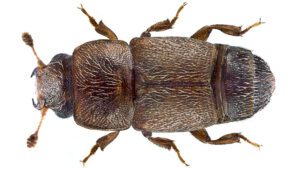
Current Research Priorities
One piece of Wilson and his colleagues’ research is focused on characterizing the phenology of carpophilus beetles in California orchards. Using cohorts of mummy nuts from almond, pistachio and walnut orchards, they have been making observations on the timing of the beetles’ activity and reproduction cycle over the course of the season, as well as tracking when the adults start to move to infest the new crop nuts.
“This was one way we could look at not just when they become active on these mummy nuts, but when we start seeing adults try to get away from the nuts and potentially up into the tree canopy,” Wilson explained.
One observation they noticed is that once hull split occurs, some adults seem to try to move away from the mummy nuts, suggesting that the beetles may be able to detect when hull split has occurred and are attracted to the new crop nuts. Based on preliminary data, these insects seem to become active in early April, with multiple generations per year. Comment by Jenny Nicolau: This feels conflicting…maybe same something early on like “some adults” then later on say something like “while others…”
However, Wilson added that not all of the adults leave the mummy nuts for good. “They seem to use those mummies all year, so it just makes it that much more important to thoroughly sanitize,” Wilson said.
Additionally, partners in Australia have published research looking at the developmental biology of this insect, including minimum and maximum temperature threshold levels and degree days needed to complete a generation. Wilson noted that under optimal conditions, the beetles typically develop from egg to adult in about four weeks, noting how temperature plays a key role in their life cycle.
That outcome was based on a trial where the beetles were fed an artificial, ideal diet, so they are now taking this information and assessing results when the beetle is fed specifically an almond, pistachio or walnut diet to see if that will impact developmental rates.
On the chemical front, Jhalendra Rijal has led trials for the past two summers, where he applied a straightforward hull split timing spray followed by a second application two weeks later. Early results indicate no measurable impact on beetle population, likely due to coverage challenges, and additional research is ongoing.
Other research has been examining infestation levels in the lower, middle and upper canopy. Australian studies suggest increased infestation levels in the lower canopy, but so far, early data collected in California shows some variability in this trend between almonds, pistachio and walnuts. Work in this area is still ongoing.
Looking ahead, the pheromone lure is an exciting potential solution being worked through with partners in Australia. Collaboration among all parties has helped identify and synthesize pheromone compounds, and Wilson and his team are helping to refine the lure’s composition and use. Wilson reported that so far the lures do indeed seem to attract quite a lot of beetles, with a large proportion of them being Carpophilus truncatus specifically.
Looking Ahead
Addressing a pest of this magnitude requires outreach, education and collaboration. Across the state, Wilson and colleagues have been working to keep growers informed, with articles in trade journals, webinars and presentations at industry events.
Continued research is of utmost importance, and additional studies are underway, thanks to funding from the Almond Board of California (ABC), the California Pistachio Research Board (CPRB), and the USDA APHIS Plant Protection Act 7721 Program.
In addition to the ongoing studies already mentioned, future research priorities include evaluation of new sanitation equipment that may be more effective at shredding nuts, screening new pesticides and assessing the influence of soil conditions on pupation success.
While challenges persist, learning how to manage the carpophilus beetle remains a top priority for ABC. The coordinated efforts of growers, industry experts, farm advisors and researchers will help minimize the pest’s impact and better position the industry for the future.