 TM
TM
Orchard soil variability and its impact on profitability were one of the hot topics at the 48th annual Nickels Soil Lab Field Day.
Nickels Soil Lab is a UC research facility operated much like a commercial farm operation and emphasizes soil and irrigation technologies. It includes more than 110 acres of almond varieties, 17 acres of walnuts and three acres of olives, as well as open ground southwest of Arbuckle. The annual field day showcases current and ongoing research in those crops.
UC Davis plant scientist Patrick H. Brown discussed implications of orchard soil variability, how it affects crop yields and possible solutions for growers.
“Every modern almond tree produced by just about any nursery has the potential to yield more than 5,000 pounds. Why don’t they?” he asked.
Brown went on to say that uniform fields are a myth. Measuring per-tree yield in five almond orchards showed that a single orchard spans 10 to 100 pounds per tree and 800 to 5,000 pounds per acre.
“Yield variability is everywhere and one fertilizer rate per acre cannot be efficient,” Brown said. A critical implication of orchard variability is untapped yield potential.
He said the three components of an orchard’s production are genetics, environment and management. Genetics are fixed, Brown said, and do not change across the orchard. Environment is variable. Microclimates and topography differ across every orchard. Management, Brown said, must be optimized across the orchard to match spatial variability.
He pointed to soil as a major limiting factor in orchard yield variability.
Understanding the Soil Profile
Applying the results from a soil sample analysis will not be successful because managing field inputs to the field average means underfeeding the highest-yielding trees and overfeeding the rest of the orchard. Knowing the soil variability in an orchard can be difficult, Brown said. Soil testing is expensive and does not supply enough information to map an entire block. Growers also need software and decision support to manage soil variability.
To get the level of information needed for management decisions, soil profile information is critical.
To optimize management, Brown said yield variability must be measured and the cause must be understood.
There are two strategic paths to overcoming orchard yield variability. Path 1, Brown said, is to adapt and match fertilizer rates to existing soil variability, reducing waste without changing the orchard potential. This is the $48,000 solution, he said. The alternative path involves identifying the limiting factor in the soil and bringing all orchard zones to the 4,000-pound-per-acre production level, a much more expensive solution.
To make these strategies work, variability must be measured. That involves high-resolution crop yield and tree performance mapping with individual tree data at harvest. To understand the cause of variability, high-spatial soil chemical and physical mapping are needed. Brown noted that software is needed to convert yield and environment into a recommendation. The final piece is site-specific application capability. This includes the ability to execute spatially differentiated inputs.
Tools and Technologies
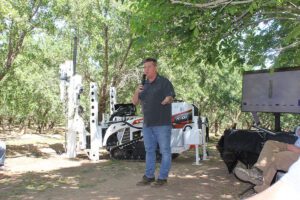
Dan Rooney, CEO of LandScan, took the variability discussion a step further with tools and technologies to apply site-specific capability.
He also demonstrated new soil collection technology that can provide many more soil samples and a drone mapping system that allows management decisions to be made with actual field conditions. The drone can provide a 3D scan of tree canopies, showing actual shapes, not just color. Together, he explained, these technologies can connect tree performance with the soil. Tissue samples are not enough, Rooney said. Scanning the canopies will reveal the underperforming trees.
Expanding on Brown’s reference to genetics, environment and management (GEM), Rooney said agricultural outcomes are driven by the interaction of these factors. Genetics are the inherent yield and quality potential of a cultivar or hybrid. Environment is the physical and climatic context in which a crop grows, most critically soil properties, rooting conditions and water dynamics. Management is the operational decisions applied to the system, including irrigation, fertility, amendments and cultural practices.
Performance is not determined by any one of these factors. It emerges from how well they are matched and managed together in space and over time.
The trial at Nickels looked at soil texture and sodium to make recommendations for irrigation.
Rooney said that GEM, applied correctly, is not about chasing maximum yield, but about allocating resources intelligently, investing where the environment allows a response, reducing where there is excess and managing what is controllable within the constraints of the landscape.
Targeting the Root Cause
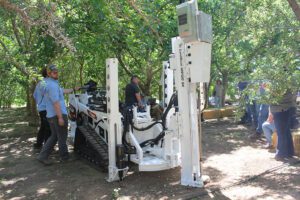
Rooney demonstrated soil collection with LandScan’s trademarked Digital Soil Core, which helps answer why soil conditions exist and what to do about them. This probe has seven independent sensors that are pushed into the ground at a continuous rate to characterize the full soil profile to a depth of 120 centimeters in less than a minute.
The Digital Soil Core can be used to provide ground-truthing between plant performance and behavior and the environment.
It can also be used to investigate and monitor the soil-water profile under varied irrigation practices or used as a baseline to monitor soil carbon and health over time.
Application technologies include irrigation blocks subdivided into irrigation zones to match the spatial resolution of yield maps, localized injectors to deliver site-specific amendments and nutrients at the tree or zone level and variable-rate technologies with hardware to deliver inputs.
As an example, Rooney commented on a case study optimizing gypsum amendment in an almond orchard. The 50-acre block in Kern County had a southeastern corner that exhibited a high replant rate and low vigor. That section of the block was also noted for poor infiltration compared to the rest of the block. LandScan’s Root Cause Analytics, an applied decision intelligence engine, identified soil chemical hardpan conditions, including excess sodium, insufficient soluble calcium and elevated SAR. These conditions were linked to higher water-holding capacity and lower hydraulic conductivity compared to the rest of the block. Rooney said the RCA analysis calculated gypsum demand to correct the calcium deficiency and increase infiltration, providing significant savings over an orchardwide application while addressing the most acute need in the field.
Publisher’s Take
The Big Picture: What to do Next
1. Soil variability is a major yield limiter
Even orchards with identical genetics can produce dramatically different yields because of soil differences.
2. Field averages can hide problems.
Managing to an average fertility rate may underfeed top-producing areas and overfeed weaker zones.
3. Soil profile data is critical
Traditional soil sampling often lacks the resolution needed for site-specific management decisions.
4. Precision technologies can improve ROI
Tree mapping, drone imagery and high-resolution soil scanning help identify where inputs will provide the greatest return.
5. Targeted amendments save money
Site-specific applications, such as gypsum only where sodium issues exist, can improve performance while reducing costs.

Cecilia Parsons | Associate Editor
Cecilia Parsons has lived in the Central Valley community of Ducor since 1976, covering agriculture for numerous agricultural publications over the years. She has found and nurtured many wonderful and helpful contacts in the ag community, including the UCCE advisors, allowing for news coverage that focuses on the basics of food production.
She is always on the search for new ag topics that can help growers and processors in the San Joaquin Valley improve their bottom line.
In her free time, Cecilia rides her horse, Holly in ranch versatility shows and raises registered Shetland sheep which she exhibits at county and state fairs during the summer.