 TM
TM
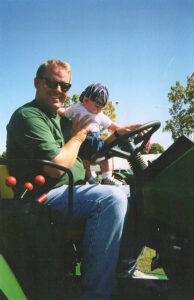
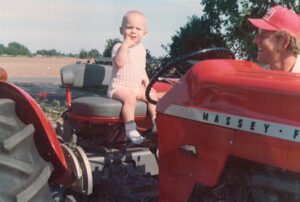
Jeff McKinney’s parents knew early on that he would be a farmer.
“My parents always said, ‘We knew when you were 10 years old, you were going to be a farmer,'” he said.
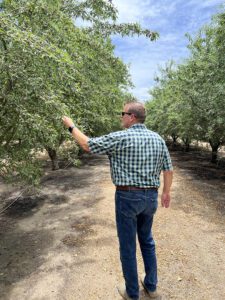
Now McKinney owns and operates McKinney Family Farming, a family-run operation of just under 1,000 acres of almonds. McKinney owns half the acreage and manages the other half for absentee owners.
In addition, he runs a custom harvesting business. His son, Mason, owns McKinney Ag Insurance, but he comes back to the farm to help with harvest every year.
“We take on about another 800 acres of harvesting ground for neighbors and different clients around the area,” McKinney said.
West Coast Nut sat down with Jeff and Mason McKinney to learn their thoughts about their family business and the almond industry as a whole.
Deep Agricultural Roots
Tell me about your farming operation.
Jeff McKinney: I was fortunate to have two grandfathers, one in the cattle business who came from Tennessee to California in the 30s, and another grandfather who was in the grain and cotton business and eventually in the almond business.
I always enjoyed farming and my brother enjoyed ranching, so that’s the direction each of us took as careers. I’ve been farming here ever since. The ranch we’re on now, my grandpa purchased land in Madera County in the mid-1950s and planted his first almonds in about 1964.
I was born and raised here in Madera and actually live in the same house where I grew up. I always joke I just moved across the hallway. I had a lot of good mentors along the way, my dad first and foremost, along with my grandpa. And now it’s me and my son running the operation.
I went to Fresno State. I graduated from high school in 1989, then went to Fresno City College for longer than I should have and eventually graduated from Fresno State University.
Did you ever consider doing anything else?
Jeff McKinney: I had a job off the farm for about two days. Fresno is about 20 miles north of us, and I was living in Fresno during college. One day I decided I was tired of driving back home every day and decided I was going to get a job in Fresno. That lasted about two days. I realized I belonged at the ranch.
Every decision he’s made on the farm has been about what’s in the farm’s best interest 10 or 20 years from now.
— Mason McKinney on his father’s long-term approach to farming
Mason, what’s your story?
Mason McKinney: I was born and raised in Madera. I went to college at Arizona State for global ag business, and I always thought I’d come back and work on the farm full time.
My dad and I had a conversation, and we weren’t sure how farming was going to be 10 years from then. My dad encouraged me to try something else but always told me I could come back to the ranch when I wanted to.
I lived in Arizona after graduation for about six months, and I realized I didn’t want to be away from home. I moved home and was offered a job in crop insurance, and that sort of took off. I mainly work on the ranch during harvest time, and usually the insurance business takes up most of my time outside of that.
Technology Changes the Industry
How have you seen farming practices evolve over the years?
Jeff McKinney: I guess first and foremost, technology from top to bottom.
We’ve got everything under microsprinklers. Almost everybody is under drip irrigation or microsprinklers with any crop out here in California.
Then there’s equipment technology. It’s night and day from back in the 80s when I was driving sweepers with no cab. Equipment and irrigation technologies have changed the whole game out here in California.
What are the three things that keep you up at night related to growing nuts?
Jeff McKinney: Water, labor and regulation. And what?
Mason McKinney: And equipment.
Jeff McKinney: Water, labor, equipment and regulations. Trying to stay on top of the regulatory issues is sometimes not the easiest thing to do.
Water and Labor Challenges
Talk a little bit about water and what that looks like for you.
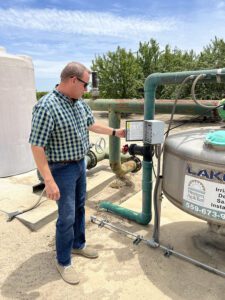
Jeff McKinney: All of our ground is in the Madera Irrigation District. The surface water we receive varies from year to year depending on rainfall and snowpack. We depend on that in years when it’s available.
I use as much surface water as I can and keep the wells off, but all of our properties are equipped with wells.
We’re fortunate to be in the water district. SGMA is starting to play a key role. If you’re not in a water district, it’s going to get tough.
What about labor?
Jeff McKinney: We’ve got some employees out here who have been with me for 25 years. I feel like we treat them well, and they stick with us.
We probably triple our workforce during harvest time. I depend on a labor contractor for that.
I get a lot of repeat employees who come back for harvest every year, which is a game changer. They know how our operation runs. They know where the ranches are. If you can get about 50% of them back, it helps immensely with the flow of harvest, training and that kind of stuff.
We keep about six full-time employees year-round, and probably half of them have been with me for more than 20 years. They are family.
Why did you choose to use a labor contractor?
Jeff McKinney: One reason is the paperwork. Two, during harvest, we need these guys and then, as soon as harvest is done, I just don’t have work for them. Using a labor contractor, they are almost guaranteed full-time work year-round because they’ll move from ranch to ranch.
The labor contractor is just easy. I’ve got a good relationship with two or three of them, and it makes my life a whole lot easier.
Optimistic About Almonds
What are you most hopeful for in the future when it comes to almonds?
Jeff McKinney: Well, I’m hopeful that the world still keeps eating them. First and foremost, if people stop eating almonds, we’ve got a problem.
Obviously, I think personally the almond market in California has peaked production-wise because of SGMA.
The grape industry in California is virtually dead. A lot of vineyards have been pulled, and a lot of those growers planted almonds, a higher-value crop.
But the future of the almond industry looks strong. We’ve got to get through these tough years, and we’re coming out of them. As long as the world keeps eating almonds, we’ll be OK.
Mason McKinney: What I’ve seen in the last six years is a lot more row crops being planted in water districts. Our neighbors had an 80-year-old vineyard. Now it has been planted in corn and tomatoes. I personally see more of that coming toward Madera rather than being on the west side.
Who do you look to for advice?
Jeff McKinney: I’ve been going to coffee with a group of guys for more than 30 years. It’s a great sounding board.
We’ve learned a lot from each other. At the same time, we’ve had a pretty good time having coffee in the morning. At the end of the day, we all care very much about each other. I used to joke that, especially during harvest or certain times of the year, I spend more time with these guys than I do with my own family.
Looking Ahead
What do you think needs to happen to set the industry on the best possible course for the future?
Jeff McKinney: Marketing. We have to keep the marketing program going. Without marketing, we’re not going to sell these almonds around the world.
Mason McKinney: I’d say let farmers farm and not be victims of regulation. I feel like my dad does so much office work and compliance, and everyone’s always worried about what we’re putting on these fields.
I think a farmer has the best interest of the ground in mind with everything they do. The public may think we are all about high-production profits and don’t care what the land looks like five years from now, but that’s just not true.
Jeff McKinney: We’re stewards of this land. We’re going to be here forever, I hope. So we take care of what’s important to us, but sometimes it gets very frustrating. That’s true with any industry. It’s not just farming.
Talk about your involvement with the Central California Almond Growers Association.
Jeff McKinney: I serve on the board of directors at Central California Almond Growers Association. I’m starting my sixth year as chairman, and I’m in my 11th year on the board.
I take a lot of pride in being chairman. My dad was chairman of Central California Almond Growers. It’s a co-op with about 363 growers servicing about 62,000 acres of almonds every year. It’s one of the world’s largest almond hullers by volume.
It’s rewarding. I get to work with some great people there.
How are you involved in your community?
Jeff McKinney: I’ve been actively involved in several ag organizations over the years. One that I’m involved in pretty heavily right now is the Madera County Ag Boosters. We donate money strictly for ag youth in the Madera County area.
I also served on the Madera County Farm Bureau board for close to 15 years. I got off a few years ago, and Mason took my seat.
I’ve always been taught to give back to the community. My parents were actively involved in social clubs and events that raised money for children. It kind of rubbed off on me, and Mason is now doing a lot of the same things.
What kind of advice would you have for a young person interested in getting into nuts today?
Jeff McKinney: You better be strong-willed. If you’re not coming from a farm family, it’s tough, but I’ve seen
it done. It’s tough to start farming from scratch. I don’t want to say it’s impossible because we’ve seen it done,
but it’s tough.
Mason McKinney: My dad always taught me to think long term. Every decision he’s made on the farm has been about what’s in the farm’s best interest 10 or 20 years from now. It’s not about buying a piece of property, making money for a couple of years and then dumping it. He’s been forward-thinking, and I’ve tried to apply that to my business as well.
What does a succession plan look like?
Jeff McKinney: I remember my grandpa and my dad saying in the 1980s when they knew I was going to be a farmer, “I don’t know what the future holds.”
Here I am 35 years later, still farming. I told the same thing to Mason. I don’t want to say I pushed him away from the ranch, but I wanted to provide him an opportunity. If he didn’t want to come back and be fully involved in the ranch, he didn’t have to. There was no obligation.
I think the crop insurance business has been a good business for him. He’s fairly new as a business owner, but he’s really thriving in it, and I’m happy to see that.
Like he said, he’s out here. He knows what’s going on. If something happens to me, with the help of others, things will still keep going. I’ve told all the kids there is no obligation to keep any of this when I’m gone. Not everybody wants to be a farmer.
Mason McKinney: My dad has been a great mentor for me. He’s never forced me to be involved. Always long-term thinking. I’m very proud of our family operation even though I’m not fully involved. It’s the McKinney family blood, and I’m very proud to be a part of it.