 TM
TM
Almond trees that retain green, viable leaves into late fall are set up for good production the next growing season. Severe or even significant loss of leaves before or after harvest can impact next year’s almond crop.
Donny Hicks, grower relations for RPAC, said premature loss of 20% to 25% of the leaves on a tree is considered significant. Premature loss of 30% to 50% of leaves is considered severe.
Retaining viable leaves allows photosynthesis to continue. This means more carbohydrates will be stored to serve as an energy source the next growing season. Flower and bud differentiation, as well as bloom strength the next season, rely on the energy stored in the tree.
Healthy leaves also send nutrients back into fruiting spurs before dormancy.
Water stress postharvest is one reason for premature leaf drop in almond orchards. Irrigation should resume as soon as possible after harvest to prevent severe water stress and premature defoliation. Hicks said trees defoliated before or at harvest can push new leaves if irrigation resumes. It is not an ideal situation, he said, but the new leaves can help with energy storage.
“After harvest a shot of nitrogen does a lot of good,” Hicks said.
Nutrients need healthy leaves for uptake. Postharvest applications of zinc or boron should be driven by leaf testing while leaves are still functional on the tree.
Monitoring Orchards
UC IPM guidelines advise monitoring orchards throughout the growing season for early detection of pest flare-ups or disease pressure.
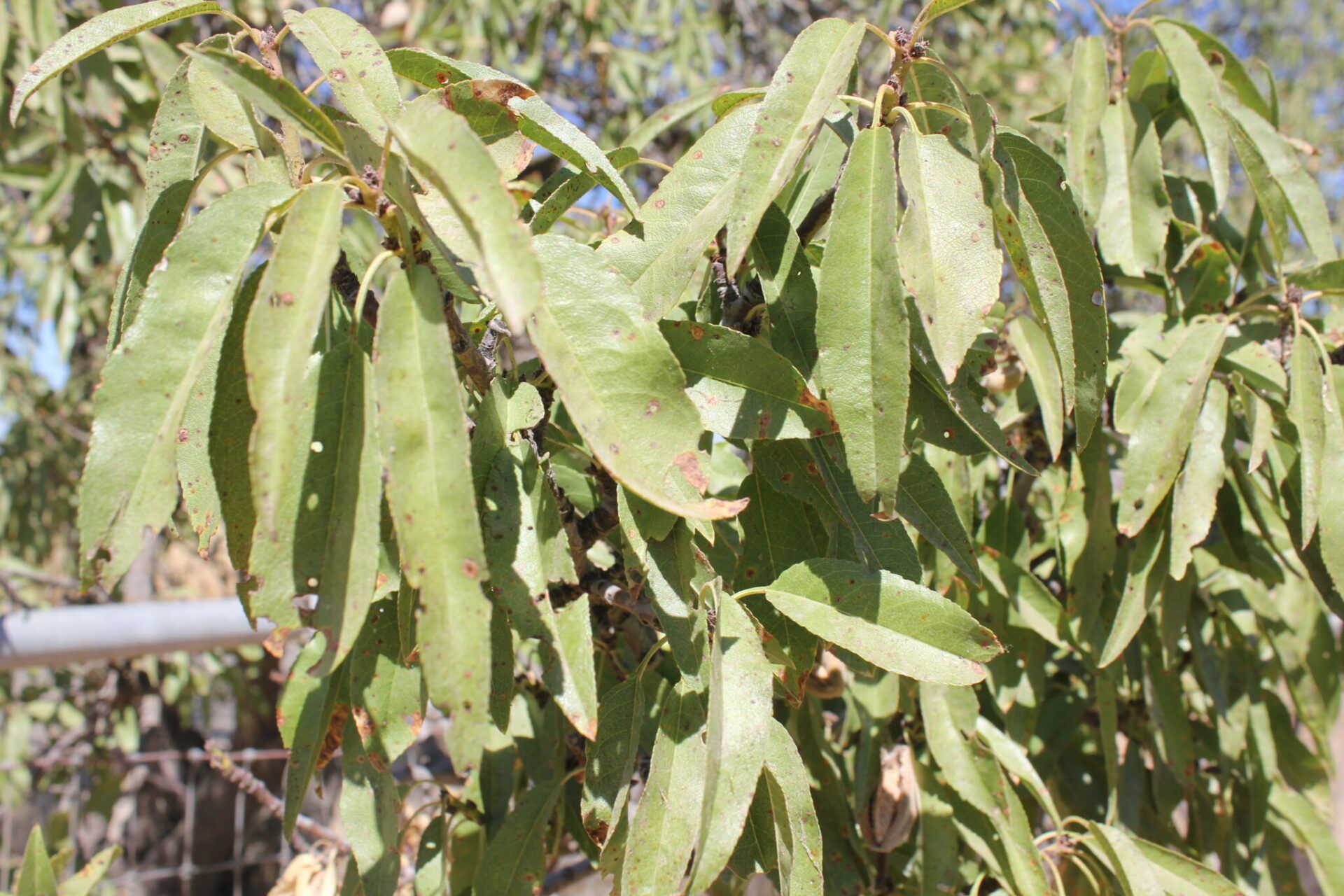
Unchecked mite infestations can cause severe defoliation in orchards as mites suck liquid from leaves, causing them to dry and drop. Populations can increase rapidly in warm weather, dusty conditions and when trees are stressed. Early signs of mites include yellow stippling on leaves. Over time, extensive webbing can appear. Hicks noted that when webbing levels are high due to mites, miticide applications become less effective at reaching the leaf surface.
The fungal diseases rust and almond red leaf blotch are also causes of early defoliation.
Rust appears as small, yellow spots on the upper surface of leaves. On the lower surface of the leaf, these spots take on a rusty red appearance when rust-colored spores produced in the lesions erupt through the surface. These spores are spread by air movement and infect other leaves, continuing the disease cycle.
Severe rust infections can quickly defoliate a tree. Rust is often observed in second- and third-leaf nonbearing orchards where fungicides have not been applied.
The development of rust is favored by humid conditions. Excessive levels of nitrogen are also known to increase the tree’s susceptibility to the disease.
Red leaf blotch is a newer pathogen in almonds and has caused severe defoliation in orchards. It was first detected in 2024 and has since spread to all almond-growing regions in California.
Leaf blotches are initially yellowish, turning orange to reddish-brown as the growing season progresses. The first symptoms can be noticeable in mid- to late April, approximately five to six weeks after the initial leaf infections. New symptoms can appear through June on the leaves of actively growing shoots. At advanced stages of disease development in June and July, leaves become necrotic, curl and drop prematurely.
Leaves infected with these pathogens serve as a reservoir for overwintering fungal spores. If possible, they should be removed from orchard floors.
Hicks said natural leaf drop in late November to early December is welcome because any remaining mummy nuts on the trees can be spotted and removed during orchard sanitation.

Cecilia Parsons
Cecilia Parsons has lived in the Central Valley community of Ducor since 1976, covering agriculture for numerous agricultural publications over the years. She has found and nurtured many wonderful and helpful contacts in the ag community, including the UCCE advisors, allowing for news coverage that focuses on the basics of food production.
She is always on the search for new ag topics that can help growers and processors in the San Joaquin Valley improve their bottom line.
In her free time, Cecilia rides her horse, Holly in ranch versatility shows and raises registered Shetland sheep which she exhibits at county and state fairs during the summer.