 TM
TM
New technology is moving quickly in almond production, but adoption still comes down to a grower’s bottom line and the questions of whether it will work and whether it will pay off.
From autonomous equipment to beekeeping supported by AI, new technologies entering almond production are increasingly focused on improving efficiency while maintaining profitability in an environment that grows more complex each season.
A recent field demonstration at Agriland Farming Company in Chowchilla gave growers the chance to evaluate some of these tools based on real-world performance, not just promise.
Autonomous Equipment Expands in Orchards
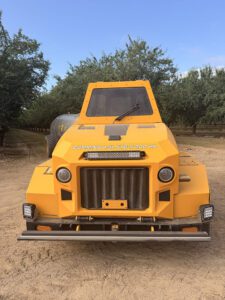
Autonomous orchard equipment opened the field event during a presentation from Orchard Machinery Corporation and Bonsai Robotics.
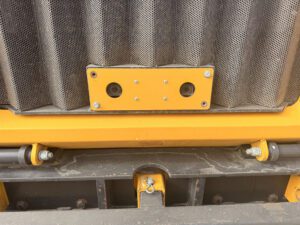
Presenters walked growers through a vision-based autonomous orchard tractor equipped with cameras and AI-driven software designed to navigate orchard rows and operate equipment remotely.
The system is being developed for applications including spraying, mowing, winter sanitation and orchard shaking.
It uses cameras and real-time data to operate without human input, identifying objects and navigating orchard conditions through machine vision.
The machine originally began as an almond shuttle before evolving into an autonomous orchard tractor capable of operating PTO and hydraulic equipment while collecting field data throughout operation.
“We basically started with the hardest version, which was a shaker,” said John Krum, marketing director with Orchard Machinery Corporation, while discussing the ongoing development of autonomous orchard equipment.
According to presenters, growers can assign jobs remotely through a mobile device while the system collects operational data throughout the process.
Safety systems built into the platform are designed to stop the machine if obstacles are detected in the field.
Company representatives said the technology is already being used commercially in Australia and continues expanding into orchard operations in California.
The technology is designed to reduce labor demands while simultaneously collecting large volumes of field data.
AI-Supported Beekeeping Targets Pollination Challenges
Pollination was also on the agenda, as growers continue to face challenges with hive health and availability.
BeeWise co-founder Eilyah Radzyner highlighted an AI-supported system designed to improve hive survival and monitoring.
He said that pollination reliability remains a growing concern for almond production as commercial beekeepers continue facing heavy hive losses.
“No bees equals no crop,” Radzyner said.
Radzyner said commercial beekeepers today are losing about 50% of hives annually, a level he described as unsustainable long term.
“Think about losing half your trees every year, half your chickens every year, half your cows,” he said.
“It would be unsustainable in any other industry.”
According to Radzyner, one of the biggest challenges in commercial beekeeping is logistics.
Hives are spread across large distances, forcing beekeepers to spend significant time traveling between locations rather than monitoring colonies directly.
He said beekeepers spend about 40% of their time in the car.
To address the drive time, BeeWise developed what it describes as a remote beekeeping system designed to monitor and manage hives in real time.
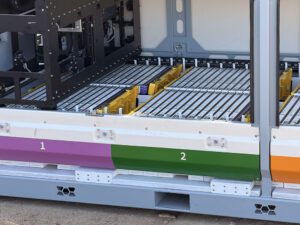
The company’s “Beehome” units house eight hives alongside a robotic arm and an AI-guided monitoring system capable of scanning frames, detecting colony conditions and assisting with management tasks remotely.
According to the company, the system allows beekeepers to identify problems earlier while reducing labor and field visits.
The company has reduced annual hive losses from about 50% to under 10% in operations using the system, according to Radzyner.
He noted that growers working with the system have also reported earlier bee activity during almond bloom, an outcome tied to the controlled environment within the units.
Irrigation Efficiency and Automation
Irrigation technology demonstrations at the field day focused on efficiency and automation as growers continue facing increasing pressure on water use and production costs.
Brian Spain, president of AgriWater, discussed advances in drip irrigation design, automation and distribution uniformity aimed at maximizing water efficiency in orchard systems.
“In the irrigation world, we are constantly tasked with making the most efficient use out of the water that we have available,” Spain said.
He showed the crowd an example of pressure-compensated drip emitters designed to deliver consistent water output across orchard systems despite changes in pressure.
According to Spain, modern drip irrigation systems in California orchards can achieve about 90% water-use efficiency, significantly higher than traditional flood irrigation methods.
“With uniformity comes efficiency,” he said.
He also highlighted increased use of automation in irrigation management, including systems capable of remotely operating pumps, monitoring reservoirs and controlling irrigation valves through mobile devices.
As irrigation costs continue rising, Spain noted growers are also increasingly seeking grants and outside funding sources to support system upgrades and improve long-term water efficiency.
Growers Focus on What Works
While equipment on hand focused heavily on technology and operational efficiency, later discussions throughout the day touched on regenerative agriculture and broader sustainability approaches within orchard systems.
Presentations throughout the day focused on technologies and practices aimed at improving efficiency, addressing labor and water challenges and supporting long-term orchard sustainability.
“As you guys know, getting labor can be a challenge,” said OMC’s Krum.
“People don’t work 24/7, but machines can.”
Publisher’s Take
The Big Picture: What to do Next
1. Evaluate where automation could replace hard-to-fill labor positions
Autonomous mowing, spraying and sanitation equipment may help reduce dependence on seasonal labor while increasing operating hours.
2. Ask equipment companies for real-world ROI numbers before investing
Growers should compare fuel, labor, maintenance and operating costs against current equipment systems before adopting autonomous technology.
3. Monitor pollination reliability and beekeeper hive health more closely
Hive shortages and colony losses remain a concern, making communication with beekeepers and early hive reservations increasingly important.
4. Review irrigation uniformity and automation opportunities
Pressure-compensated drip systems and remote irrigation controls may improve water-use efficiency and reduce labor demands during irrigation season.
5. Prepare for more data-driven orchard management
New orchard systems increasingly combine field operations with data collection, allowing growers to track efficiency, equipment performance and orchard conditions in real time.