 TM
TM
Hazelnut grower Greg Satrum once thought of bare orchards as being well maintained.
“Now I see missed opportunity,” he said. “Plants are how we intercept the energy of the sun and turn it into something beneficial for soil. Sun on bare soil is destructive.”
Welcome to the mindset of a farmer who eight years ago started using cover crops for erosion control.
The Canby, Ore., orchardist today is focused on feeding soil on his orchard floor with living tissue that produces sugars through photosynthesis that feed soil microorganisms and build soil health on a farm that for decades practiced conventional tillage on a sweet corn and wheat rotation.
And it started with a simple desire to stop erosion.
“That was really my only goal,” he said. “But once we started learning more about cover crops, we were learning there’s a lot more possibility here.”
Today, triticale, oats, clovers, hairy and common vetch, creeping red fescue, annual ryegrass, meadowfoam and phacelia can be seen growing in the alleyways of Satrum’s orchards.
“You can address a lot of the pest and disease issues in the orchard canopy through careful management of the orchard floor through cover cropping.”—Todd Anderson
The creeping red fescue keeps soil in place. The clovers and other legumes suppress weeds and fix nitrogen. The plant mixes take up moisture faster than if farming on bare soil, allowing Satrum to get into orchards sooner after rain events.
“It drinks up moisture a lot better than soil that doesn’t have any cover,” he said.
And his orchard soils are becoming healthier every year.
“We are building our soil functions, but it’s a slow process,” Satrum said.
Satrum is among a growing number of hazelnut farmers who today incorporate cover crops on orchard floors that once stood bare. For years, he said the consensus was that for an orchard to succeed, it should be devoid of plants in the alleyways and tree rows.
That mindset is changing.
“In a conventional mindset, the best thing I could do is kill every living plant other than the tree, which would eliminate all the competition, and the trees would be better off as a result,” Satrum said. “And then I’d feed the trees some nutrients and you’d have no other plants stealing nutrients that aren’t producing income. Maybe that’s 20% true, but it’s not the whole story.”
Influencing Pest Diversity
Todd Anderson, Oregon State University Extension organic tree fruit and nut specialist, said growers like Satrum are not only building soil health through use of diverse cover crop mixes, but they are also changing the makeup of their orchards.
“Diversity doesn’t just go into the soil,” Anderson said. “How diverse your cover crop is influences the insect diversity in your orchard and influences your pest diversity in the orchard canopy. So, you can address a lot of the pest and disease issues in the orchard canopy through careful management of the orchard floor through cover cropping.”
Anderson added that a good cover crop mix can do wonders for nutrient cycling, as well.
“There are some growers who are meeting almost all their nitrogen needs through cover cropping,” Anderson said. “And in a reality where imported fertilizer is just going to be more expensive, whether you’re organic or conventional, that is essential.”
Annual cover crops are particularly valuable when used in the interim between pulling out an old orchard and planting a new one, Anderson said.
“It helps with disease suppression, breaking up disease cycles and ensuring the best health for the new trees.”
Some Drawbacks
Satrum said he has encountered drawbacks to cover cropping, including the cost of mowing orchard floors six to seven times a year, the cost of seeding cover crops and the fact that it takes longer to harvest because of uneven orchard floors.
“Instead of sweeping at six or seven miles an hour, we’re sweeping at three or four miles an hour,” Satrum said. “We have a lot less dust to deal with, so it makes harvest more pleasant, but we do have more time on the sweeper, and it is a cost.”
He added that, with some exceptions, he typically can get away without treating alleyways with herbicides, but at times that too can be an additional cost.
“Typically, mowing is all we need to do,” Satrum said. “But some years we will do a herbicide treatment before we get into harvest season when battling difficult weeds like dandelion and mallow.”
His foray into cover crops also has involved a learning curve, with some trial and error that at times has cost some yield.
He recently found, for example, that the legumes in his cover crop mix were not fixing as much nitrogen as he thought, leading to insufficient nitrogen inputs.
“It’s not something you figure out overnight,” he said. “It’s a trial-and-error thing. You’d like to think you know what you’re doing by this age, but that’s not the case.”
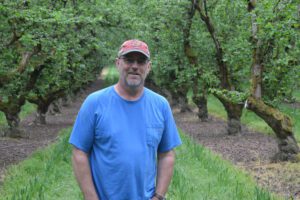
Satrum said he is also still searching for the optimum mix and finding in some cases he may be adding too much competition to orchard floors.
Grasses, for example, are a great way to stabilize soil in young orchards, he said, but they may not be the best cover crop for mature orchards.
“As the trees get bigger and their roots are reaching out further, I think we need to move to covers that are less competitive,” he said. “I’m not sure that grasses are the tree’s favorite cover to live with. I don’t think they are bad, I just think that they need to be maybe 20% of the mix, rather than 80%.”
Still, Satrum said the benefits of cover crops far outweigh the drawbacks.
Take, for example, what he has learned from the farm’s oldest orchard, a Barcelona orchard now 40 years old and infected with Eastern Filbert Blight.
The trees in good soil, he said, are still productive. The ones in marginal soil are severely infected and being pulled out on a regular basis.
“We have entire trees falling over because the blight is clear down in the trunks,” he said. “Trees in other areas are still doing well.”
The difference is soil, he said.
“A tree seems to be able to survive EFB a lot better if it’s in good soil,” he said. “That is one of the things that makes me think about these young orchards. Anything we can do to help soil health in a young orchard is going to help us live with some of these diseases better.”
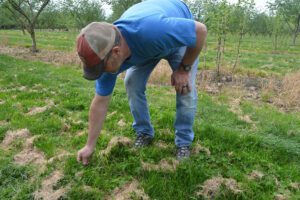
Today, as he reaches down and pulls up soil that once hit hardpan six or eight inches below the surface, he sees healthy soil that is ready to convert energy gathered from cover crops into microorganisms that feed soil health.
“We’ve stopped erosion,” he said. “We think we’re building soil health. Now we’re focusing on planting covers that the trees want to grow with.”
Publisher’s Take
The Big Picture: What to do Next
1. Cover crops can reduce erosion and improve soil structure
Cover cropping began as an erosion-control strategy but has since improved water infiltration and soil function in his orchards.
2. Diverse cover crop mixes may support beneficial insects and nutrient cycling
Oregon State University researchers say orchard floor diversity can influence pest pressure and improve nutrient availability.
3. Cover crops may reduce fertilizer needs over time
Legumes and mixed-species covers can contribute nitrogen and improve nutrient cycling, though growers still need to monitor nutrient levels carefully.
4. Management costs and harvest logistics can increase
Cover crops may require more mowing, additional seeding expenses and slower sweeping speeds during harvest.
5. Cover crop systems require trial and error
Finding the right species mix and balancing competition with tree needs takes time and ongoing adjustments.