 TM
TM
In orchards and specialty crops, robotics are increasingly used for tasks like pruning, harvesting and field scouting. Autonomous machines can move through rows collecting data on tree health, canopy size, irrigation performance and pest presence.
Some systems can also map problem areas, helping growers prioritize management decisions.
Robotic Research
University of California, Merced researcher Reza Ehsani, professor of mechanical and aerospace engineering, is working on robotics research for agriculture.
He and colleagues developed a sensor clip that is used to measure leaf water content in trees.
“We are trying to develop an algorithm for irrigation scheduling for nut trees based on the reading from our sensor,” Ehsani said.
Measuring leaf water content is currently done manually, which is time-consuming and labor-intensive, and not practical for large farms with hundreds of acres to cover.
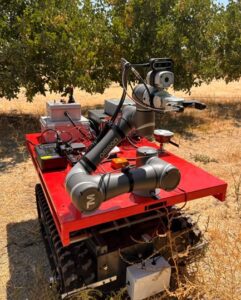
Researchers integrated the sensor into a robotic arm, then developed an algorithm so the robot goes from one tree to another.
A small spectrophotometer has been integrated into the robotic arm to measure leaf-level spectral information, plus disease and nutrient deficiency. This could potentially enable researchers to collect more data from the fields and help better optimize nutrient applications in the orchard.
Ehsani said a key challenge for growers is managing mummy nuts. This issue could be addressed with the system’s advanced sensing capabilities.
Equipped with multiple cameras, including thermal, stereo vision and standard imaging, the robot can collect a wide range of data as it moves through the orchard.
He explained that the technology can not only identify and count mummy nuts, but also generate detailed maps showing their distribution across a field. This information allows growers to prioritize areas with higher concentrations and better plan winter sanitation efforts.
Ehsani noted that this is especially important for managing issues associated with Carpophilus truncatus and navel orangeworm, where removing mummy nuts is a critical control strategy.
By pinpointing problem areas, growers can make more informed decisions about where to begin and how to allocate resources for the most effective results.
“Mummy nut mapping is not difficult, and measuring moisture content is something that’s already being done. But if you say, ‘Can you identify certain diseases?’ then that will be a little longer because the sensor has to be recalibrated for that particular disease and collect some data to train the model to predict that,” Ehsani said.
Working with Professor Carpin in the computer science and engineering department at UC Merced, researchers are developing a robot that uses a large language model allowing users to talk to it rather than program it.
“You can tell it to go to row number three, tree number five, and collect three leaf samples,” Ehsani said, adding that it also responds to any language.
Ehsani said the goal is to have robots handle this type of labor-intensive work. He explained that the system is being developed so the robot can operate autonomously.
The robot is fully electric, designed to recharge and then resume operations, moving from tree to tree with minimal human intervention.
“The platform itself doesn’t use much electricity, but because it uses different types of sensors and arms, it does draw some energy.
“These are the things that are coming, and hopefully growers will start to see them in a couple of years,” Ehsani said, adding the technology is growing rapidly in this area.
Ehsani said the project is now in its second year and continues to evolve as improvements are made.
The technology has moved beyond the lab and is currently being tested in real-world field conditions, where it is actively collecting and connecting data.
He noted that, like most research, challenges emerge once systems are deployed in the field, requiring ongoing adjustments and refinements to address issues encountered in real operating environments.
Autonomous Machines
Tyler Niday, co-founder and CEO of Bonsai Robotics, said the company develops autonomy software that integrates into various pieces of agricultural equipment.
Its vision-based AI enables machines to perceive and act independently, understand their surroundings, navigate complex terrain and perform tasks safely and efficiently.
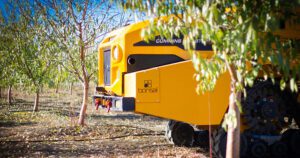
From shaking and spraying to sweeping and mowing, Bonsai has integrated its autonomy into OMC and Flory orchard equipment, as well as Amiga, its own line of machines targeting specialty crops, to help growers complete jobs up to 60% quicker and lower operating costs by up to 45%.
For example, the Shockwave X with Bonsai Intelligence works day, night and in low visibility for maximum uptime, shaking up to seven trees per minute.
Niday explained that the AI system not only guides the machine through orchard rows, but also continuously adjusts the harvesting head, moving it in, out, up and down, to maintain optimal positioning and ensure each tree is effectively shaken.
He noted that one of Bonsai’s integrations is the OMC AR-500, a 200-horsepower specialty tractor designed to compete with major brands like John Deere and Case IH.
Unlike traditional tractors, it relies entirely on hydraulic power rather than a PTO, which he pointed out is one of the most dangerous components on farms and a leading cause of fatalities.
Niday added that the AR-500 doubles as a shuttle truck used to transport nuts from the field, a role it typically fills for only about 45 days each year.
However, OMC designed it with versatility in mind.
The rear bin can be swapped out for a Category 3 hitch and PTO, effectively converting it into a high-performance tractor for an additional investment. When equipped with Bonsai Intelligence, the machine can also be used for autonomous mowing and herbicide application, potentially operating up to 2,500 hours annually. This expanded functionality significantly increases its return on investment.
He also highlighted the Flory V62 V-Sweeper, which is used to sweep nuts during harvest.
Bonsai Intelligence boosts productivity with operator-assisted steering, expanding daily acreage coverage by 20%.
Bonsai purchased farm-ng in July 2025, adding the Amiga product line to its offerings, a series of modular electric and hybrid robots designed to tackle tedious, time-consuming tasks like spraying, weeding and mowing.
Labor Savings
Labor is always an issue in agriculture, from cost to availability.
Currently, Bonsai Robotics has about 70 OMC and Flory units deployed, the majority in Australia, and two large producers in the United States are using the products. Niday pointed to Australia as an example of where large-scale farming and labor shortages are accelerating the adoption of automation.
He noted that operations there often span 5,000 to 10,000 acres and are located far from major population centers, making it more difficult to secure a reliable workforce.
He said innovations adopted in Australia often make their way to the U.S., and that trend is beginning to take shape with agricultural technology. When a grower sees significant reductions in operating costs, it can shift the competitive landscape.
According to Niday, those who adopt effective technology early are often positioned to gain a long-term advantage.
Niday said he has started seeing an uptick in interest, particularly with large corporate farmers who know they need a strategy around autonomy, and labor is the big driver of that.
“By handling several functions in a single pass, the technology is designed to improve efficiency while taking over time-consuming tasks that are often not cost-effective to assign to workers.” — Reza Ehsani, University of California, Merced researcher
Niday explained that while the OMC machine functions as a tractor, it was originally designed as a shuttle truck, typically a $200,000 piece of equipment used only during harvest and then parked for the rest of the year. For an additional cost, growers can add a conversion package and Bonsai Intelligence to convert it into a highly capable autonomous tractor.
He compared its functionality to autonomous orchard sprayers like GUSS, Global Unmanned Spray System, noting that the machine can handle spraying and mowing without an operator. Its multipurpose design allows growers to get year-round use from equipment that would otherwise sit idle, making it a more cost-effective alternative to purchasing a separate tractor.
Niday added that, unlike traditional labor, the machine can operate continuously, running 24/7 if needed, which could significantly increase productivity and efficiency in orchard operations.
New Applications on the Horizon
“We are working on a hybrid electric weeder on our robotic platform, the Amiga Max, so that’s a big one that’s coming down the road,” Niday said, adding the plan is to have it in the field this year. “The first one will be a demo unit, and then sales will kick off in 2027.”
Niday also highlighted the company’s Bonsai Pilot Teletrace system, which connects equipment to a centralized digital platform that can be accessed via phone or computer.
The system provides real-time insights into farm operations, allowing growers to monitor activities such as harvesting and spraying across one or multiple locations. He said users can generate daily, weekly or monthly reports to track performance in detail and evaluate operational efficiency.
Metrics such as trees harvested per minute or per day, machine locations and downtime can all be monitored.
The platform also allows users to set up alerts, providing immediate notifications if issues arise in the field.
Niday noted that this level of connectivity and data access marks a significant step forward in how growers can manage and optimize their operations.
“The app is very intuitive and user-friendly, and we’re able to train people in less than a day and hand it off to them.
“We have a connected platform, so if there are issues, we’re able to log in from anywhere in the world and get them back up and running or help very quickly, all remotely,” Niday said.
The Future
Ehsani said the current robot is built entirely from commercially available components, including the platform, robotic arms and sensors.
The primary focus now is integrating those pieces into a system that functions reliably in real-world conditions.
He noted that once the technology is proven to work effectively, bringing it to market should be relatively straightforward, since all of the individual components are readily available.
Ehsani said robots are expected to play a key role in orchard scouting in the future, reducing the need for growers to manually walk rows to inspect trees.
Instead, autonomous systems would be able to move through the orchard and collect data while performing multiple tasks at once.
He explained that beyond monitoring leaves, the robots could check irrigation lines, evaluate watering patterns, count fruit and measure canopy size.
By handling several functions in a single pass, the technology is designed to improve efficiency while taking over time-consuming tasks that are often not cost-effective to assign to workers.
“Right now we hire somebody to go and check the irrigation line, and inspect for sign of disease or pests,” Ehsani said, “but in the future, the robot does this work.”
The expense of the machine would be diminished because it can do multiple jobs that ultimately save a grower labor and time.
Ehsani emphasized that ease of use and durability are central to the project’s design.
Any technology developed for growers must be simple, rugged and practical for real-world conditions.
Looking ahead, he said the goal is to make the system even more user-friendly, potentially allowing operators to give simple commands and have the robot carry out tasks with minimal input.
Publisher’s Take
The Big Picture: What to do Next
1. AI-powered orchard scouting could reduce labor costs
Autonomous systems are being developed to monitor irrigation lines, tree health, canopy size, disease pressure and mummy nuts in a single pass through the orchard.
2. Mummy nut mapping may improve winter sanitation efficiency
Robotics equipped with thermal and imaging sensors can identify and map concentrations of mummy nuts to help prioritize sanitation efforts.
3. Autonomous equipment is expanding beyond harvest operations
Growers are beginning to use autonomous systems for mowing, spraying, sweeping and potentially weeding applications.
4. Robotics may help address labor shortages
Companies developing autonomous orchard equipment say machines can operate longer hours and reduce dependence on hard-to-find labor.
5. Growers should expect more field-ready systems within the next few years
Researchers and manufacturers say many robotics systems are already being tested in commercial orchard environments.