 TM
TM
Hull rot remains one of the more frustrating and yield-limiting diseases in California almonds, particularly because its full impact is not always visible in the year it occurs. Recent research shared by UCCE advisors is helping clarify where growers should focus their efforts, especially as the disease complex evolves and growing conditions continue to favor new pathogens.
Disease Complex Continues to Evolve
Muhammad Yaghmour, orchard systems advisor in Kern County, has been closely tracking changes in the organisms responsible for hull rot. While the disease has long been associated with Rhizopus stolonifer and Monilinia species, the increasing presence of Aspergillus niger is shifting both how the disease develops and how it needs to be managed in the orchard.
Hull rot follows a classic disease triangle, requiring a susceptible host, a pathogen and the right environmental conditions. What makes this disease particularly challenging is that all three components are often present at hull split, when almonds are physiologically vulnerable and environmental conditions can favor fungal growth.
Infection begins in the hull, but the most damaging effects appear later as the fungus moves into the fruiting wood. Leaves surrounding infected nuts dry rapidly, and the spurs that would produce next year’s crop are killed. In severe cases, entire shoots can be lost.
Yield Losses Extend Into the Following Season
This delayed impact is critical. Yield losses are not just tied to visible infection but to the loss of next year’s bearing wood. Research conducted across multiple orchards showed that yield reductions become meaningful once strike levels reach roughly 100 per tree. At that point, the cumulative loss of spurs begins to reduce the productive capacity of the tree in the following season.
Missing that narrow window can significantly reduce the effectiveness of control measures.
— On the importance of hull split spray timing
One of the most important takeaways from this work is that not all hull rot is the same. Each pathogen behaves differently and requires different management timing. Monilinia, which also causes brown rot during bloom, infects earlier and must be managed weeks before hull split. In contrast, both Rhizopus and Aspergillus are primarily driven by inoculum originating in the soil, and infections occur at or shortly after hull split.
Aspergillus Becoming More Important
The rise of Aspergillus niger is particularly important for growers in warmer production areas. This pathogen thrives under higher temperatures and has become increasingly common in Kern County before spreading more broadly across the Central Valley.
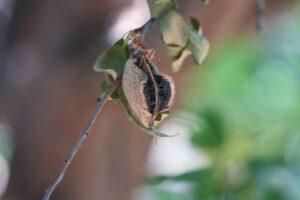
Its symptoms differ subtly from those of Rhizopus. Instead of the gray, fuzzy growth commonly associated with Rhizopus, Aspergillus produces darker, flatter, jet-black spores. It can also lead to internal damage, including black streaking in wood due to toxin production, which contributes to spur and shoot death.
Understanding when infection occurs has helped refine management recommendations. Research shows almonds are most susceptible during early hull opening, particularly when the split is still narrow. That window, when the hull has just begun to open, is when infection severity is often highest for Aspergillus.
This underscores why spray timing is so critical. Missing that narrow window can significantly reduce the effectiveness of control measures.
Variety and Cultural Practices Matter
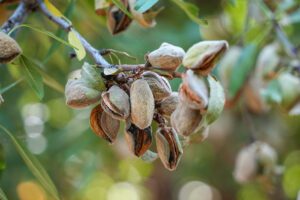
Variety also plays a role. Nonpareil, Butte and Sonora have shown higher susceptibility, while Monterey and Fritz tend to be less affected under similar conditions.
In mixed plantings, this means growers should expect greater risk in Nonpareil blocks and manage accordingly, prioritizing inputs where the return on protection is highest.
Cultural practices continue to play an essential role in reducing disease pressure. Excess nitrogen has been shown to increase susceptibility, likely by promoting lush growth that favors infection.
Hull rot management is less about any single treatment and more about matching the right tool to the right moment.
Similarly, irrigation practices influence disease development. Strategic deficit irrigation has been linked to reduced incidence of Rhizopus, while excessive soil moisture during hull split can increase disease pressure.
Dust management is another overlooked but important factor. Because Aspergillus and Rhizopus originate in the soil, any activity that creates dust can move spores into the canopy. Equipment traffic during hull split can unintentionally increase inoculum pressure at the exact time tissues are most vulnerable.
Reducing dust during this period can help limit infection.
Precision Timing Is Critical
Fungicides remain a valuable tool, but they are not a standalone solution. Their effectiveness depends heavily on correct timing and proper pathogen identification.
Materials in several FRAC groups have shown strong performance when applied at the early stages of hull split. However, applying them too early or too late significantly reduces their value.
In most cases, hull split sprays for disease management can be aligned with navel orangeworm treatments, helping to streamline operations.
For growers, the message is clear: Hull rot management is less about any single treatment and more about matching the right tool to the right moment. By scouting early, identifying the pathogen involved and combining precise spray timing with balanced nitrogen, careful irrigation and dust reduction, growers can better protect the fruiting wood that supports next year’s crop and build more resilient orchard systems over time.
Publisher’s Take
The Big Picture: What to do Next
1. Timing is everything
Almonds are most susceptible to hull rot during early hull opening when the split is still narrow.
2. Not all hull rot pathogens behave the same
Monilinia, Rhizopus and Aspergillus require different management approaches and timing.
3. Aspergillus niger is becoming more common
The pathogen is increasing in importance, particularly in warmer production regions.
4. Nitrogen, irrigation and dust all influence disease pressure
Cultural practices remain key components of a successful management program.
5. Protect next year’s crop
Hull rot damages fruiting wood and spurs, reducing future production potential even when current-season symptoms seem limited