 TM
TM
Irrigation decisions in tree nut orchards rely on information from multiple sources. Pressure bombs, ETc calculations, historic irrigation data and plain-old shovel work are all used by growers to schedule irrigations.
Years of research and field trials have resulted in more precise irrigation management in almonds. Pistachios, a relative newcomer in California compared to almonds and walnuts, present some unique challenges with irrigation given tree physiology and different growing locations. There is also variability between varieties and rootstocks.
Irrigation technology company Phytech and American Pistachio Growers presented a demonstration at a Hanford-area pistachio orchard to show growers how plant-based irrigation can help with pistachio tree growth and health while also saving on water costs.
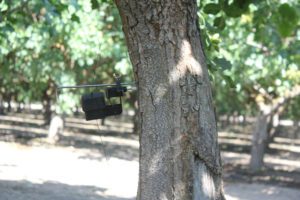
In a mature Lost Hills orchard on UCB1 rootstock, Phytech’s Mark Sherfy described the agronomic monitoring kit being used in the orchard. The kit includes dendrometers that detect plant growth and capillary action or shrinkage to catch early stress, an irrigation pressure sensor that verifies irrigation applied, timing and pressure, and a soil moisture probe to show root zone moisture. The multiple sensors that monitor the tree’s real-time physiological state present a detailed picture of tree water status for planning irrigation schedules.
Sherfy explained how the dendrometer, attached to the tree trunk, gives two measurements: the tree’s maximum daily shrinkage (MDS) and expansion, which are measured in microns. These two measurements combined give the grower feedback on the plant status by way of a daily color scheme: green is no stress, yellow is slight stress, and orange and red indicate stressed or very stressed trees. With the other components of the monitoring system, growers receive real-time information on tree water status, allowing them to adjust irrigation scheduling.
He said that during the day, as trees transpire and lose water, they contract. Sherfy said the recovery cycle begins at sunset when the roots pull water from the soil to expand, and the tree starts the next day with water needs met. The soil moisture probe shows the soil depth where the trees are pulling water.
The main goal of the agronomic kit is to maximize tree growth and health regardless of environment and variability by supplying tree water needs on that day. After harvest and through the winter, the measurements flatten, Sherfy said, but there is still a need to see steady readings as the tree stores carbohydrates for the next growing season.
Pistachio trees, unlike other tree nuts, start growth slowly and build up, then taper back again. From third- to seventh-leaf, they are growing well above 5,000 microns per year, then the number declines slowly. Sherfy said if you look at the growth in months, May through September is important for second- to sixth-leaf trees while April through July tend to be where sixth- through ninth-leaf trees grow the most. This makes sense as crop loads start to dictate development in August. He noted that pistachio trees contract and expand at different levels than almond trees. Expansion and contraction are also specific to crop load and variety.
Trees Tell the Story
When it comes to water use, mature pistachio trees are not like almonds, Sherfy said. Applying more water than the tree needs is not helpful for trunk growth. Researchers and growers alike want to be sure the trees are irrigated, but he maintains that trees, based on soil and variability in location, will grow and be productive if irrigated based on plant needs. Sherfy said the Phytech system looks at all the variables in irrigation scheduling.
“The tree tells you. If it’s not growing, you will see stress with the Phytech plant status color,” Sherfy said. The dendrometer readings can also signal nut fill as the growth pattern flattens.
He advised learning the specifics of an orchard block environment, including soil type and water source, and applying water when needed. Irrigating “outside peak” hours was suggested as trees irrigated at night experience more stress than those irrigated during the day. He noted an irrigation trial showed yield increases when irrigating during the day compared with irrigating “off peak.”
“Trees, like humans, desire water when working out, not after the day is done, but when they are working hard.”
Soil type will influence growth and water uptake. Sandier soils can handle pulse irrigations more frequently compared to clay soils. Sherfy said to wait and see the tree response to the irrigation scheduling. Sherfy said it is obvious when nut fill hits as trees pull deeper water. In early to mid-June, he said to consider putting water down deeper in the soil profile because, as nut fill starts, the pistachio trees will begin to utilize water at all depths until nut fill is complete.
Salinity and Water Savings
He noted that more growers with salinity issues are looking at plant-based monitoring, particularly in the south valley growing area where ET readings are higher.
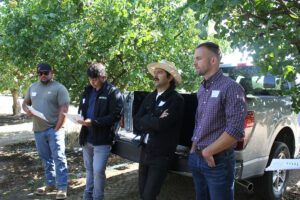
Two pistachio growers and a farm manager added their experience with plant-based irrigation scheduling at the Phytech-APG demonstration, citing water and labor savings with the monitoring kit. Juan Gomez, farm manager at Zonneveld Farms, where the demonstration took place, noted that his irrigation decisions are largely data-driven based on readings from the monitoring kit. They have allowed him to avoid overirrigating and save on water costs.
Joe Coelho, director of sustainable growth and outreach for American Pistachio Growers and a pistachio grower, said the dendrometer use plus ETc readings allow for more precise irrigations.
“From a management perspective, this type of monitoring is much less labor intensive than using the pressure bomb and is more exact.”
Coelho said being able to adjust irrigation is also important as water costs and supplies tighten.
In his pistachio orchards, he said, the aim is building healthier soils and improving water-holding capacity is where the monitoring provides a better look at tree stress. They do not directly help with soil health. However, they do help measure tree water demand, which can be directly influenced by soil health and conservation management practices. The discrepancies between ET and actual applied water in conventionally managed fields, as measured by Phytech technologies, are large, but are likely even greater in an organic matter-rich soil measured with the same instrumentation.
Publisher’s Take
The Big Picture: What to do Next
1. Let the tree drive irrigation decisions
Plant-based monitoring provides real-time data on tree stress and water needs.
2. More water isn’t always better
Overirrigation may not improve trunk growth and can increase costs.
3. Irrigation timing matters
Daytime irrigation may reduce stress and improve yields compared to nighttime irrigation.
4. Know your soils
Sandy soils and clay soils require different irrigation strategies.
5. Monitoring can save water and labor
Growers using dendrometers report better irrigation precision and lower costs.

Cecilia Parsons | Associate Editor
Cecilia Parsons has lived in the Central Valley community of Ducor since 1976, covering agriculture for numerous agricultural publications over the years. She has found and nurtured many wonderful and helpful contacts in the ag community, including the UCCE advisors, allowing for news coverage that focuses on the basics of food production.
She is always on the search for new ag topics that can help growers and processors in the San Joaquin Valley improve their bottom line.
In her free time, Cecilia rides her horse, Holly in ranch versatility shows and raises registered Shetland sheep which she exhibits at county and state fairs during the summer.