 TM
TM
Alternate bearing is an indication of how much crop yield can vary from year to year. It is measured on a scale of 0 to 1. The higher the number, the more severe the alternate bearing. An alternate bearing index of 1 is total alternate bearing: crops on alternate years. An alternate bearing index of 0 is the same crop on successive years.
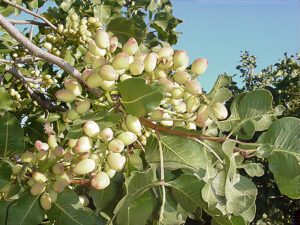
All tree fruit and nut crops alternate bear, but it is more pronounced in an apically dominant crop like pistachio, where the new vegetative growth is primarily from the shoot tip. The buds for the following year’s crop on current year’s shoot growth abscise, precipitating alternate bearing. This bud abscission only occurs on bearing shoots. It is thought to happen because the tree’s carbohydrate supplies for the following year have been depleted by the crop on the one-year-old shoot growth. It is thought, but has never been directly proven, that the depleted carbohydrate status precipitates a hormonal signal from the one-year-old shoot growth to the current year’s shoot growth, causing drop of the fruit buds.
Industry Adapted to Alternate Bearing
When the first commercial pistachio orchards in California reached maturity more than 50 years ago, the alternate bearing trait was an economic concern for growers. Input costs were steady, but a wide swing in production from year to year, particularly after waiting six years for a first crop, was a tough nut to swallow.
Back then, Kerman was the predominant pistachio variety planted, and many were on Atlantica and PGI rootstocks.
Today, new varieties, improved rootstocks and management, along with industry infrastructure, place alternate bearing in the rearview mirror.
Production swings are still there but have flattened out. Processing capacity and storage allow the industry to take “on” and “off” years in stride.
Craig Kallsen, UCCE emeritus pistachio tree crop advisor for Kern County, reported that weather in an individual year can strongly affect alternate bearing. The preceding crop year may end with sufficient buds and carbohydrate resources to potentially deliver a large crop, but weather can affect yields. Poor winter chill can decrease crop yields. Warm weather during bloom, which happened this year, can also decrease yield.
Monitoring of shoot carbohydrate levels done by the UC Davis Carbohydrate Observatory supports the premise that the current year’s yield is primarily a function of the previous year’s crop. The tree’s current-year resources, carbohydrates available to support the future crop, determine the potential crop for the following year by precipitating bud drop. This potential crop can then be decreased, but not increased, by winter and spring weather, as pointed out by Kallsen above.
“Pistachios, like all fruit and nut trees, are inherently alternate bearing, but it is more pronounced in an apically dominant tree like pistachio, so a reduced crop in an ‘off’ year is part of the normal production cycle,” Joe Coehlo, American Pistachio Growers sustainability director, said. “That said, timing of extreme weather events matters. If extreme heat occurs during the bloom period, it can hinder pollination. When those two factors align, as they may have this season, the result can be a more pronounced drop in production.”
Monitoring and understanding the effects of extreme weather events was emphasized by UCCE Department of Plant Sciences Extension Specialist Louise Ferguson in a presentation at 2026 Statewide Pistachio Day.
Ferguson also said alternate bearing is not the problem it was once thought to be. It is an interesting physiological problem that affects pistachio production, but it can be mitigated with rootstocks and canopy management.
Timing of extreme weather events matters, if extreme heat occurs during the bloom period, it can hinder pollination.
— Joe Coehlo, sustainability director, American Pistachio Growers
Rootstocks Reduce Yield Swings
Production practices, genetics of pistachio rootstocks and the industry ratio of bearing to nonbearing trees have changed in the last three decades. Ferguson noted that in 1995 a trial demonstrated severe mechanical topping entering the low crop year strongly mitigated alternate bearing in Kerman pistachios on Atlantica rootstocks. The trial demonstrated that mechanical pruning did not affect the mechanism of alternate bearing. What it did do was, by stimulating vegetative growth, produce a better composition of bearing to nonbearing shoots per tree.
A second trial, led by Bob Beede, again with Kerman, but on four seedling rootstocks: Atlantica, Integerrima and two seedling hybrids, now marketed as seedling and cloned UCB1 and Platinum, showed striking differences in alternate bearing depending on rootstock. Trees on Atlantica and PGI rootstocks strongly alternate bear, 0.79 and 0.55 respectively, but it can be decreased by about 50% by mechanical pruning entering the low crop year.
In contrast, trees on UCB1 and PGII rootstocks have much lower alternate bearing indexes, 0.29 and 0.27 respectively, 63% less than trees on Atlantica or 47% less than trees on PGI rootstocks, but the alternate bearing is not affected by the timing of mechanical pruning. The mechanical pruning can be done entering the low or high crop year and produces the same alternate bearing index of about 0.29 on both hybrid rootstocks. This is not surprising, as they are both Atlantica-pollinated by Integerrima hybrids. Ferguson said that it is the Integerrima parentage in hybrid rootstocks that introduces vigor, resulting in second and third flushes of shoot growth that, theoretically, supply the tree with a better carbohydrate status entering dormancy.
Pistachio Physiology Not Changed
The physiology of alternate bearing has not changed, nor have rootstock selection or canopy management changed the bud abscission mechanism of alternate bearing. There is strong evidence it is an evolutionary survival strategy that evolved to ensure survival of the tree by rebuilding the tree’s carbohydrate supplies and precipitating the decline of pest populations in a low crop year. When Kerman was selected for commercial production, practices exacerbated alternate bearing by making a high crop year higher, precipitating a lower crop the following year.
Lack of winter chill can intensify alternate bearing, particularly in Kerman. Chill was reported adequate this winter, but the high temperatures experienced in March brought winter dormancy to an early end.
New Varieties Show Different Patterns
Jeff Gibbons, plant manager at Setton Farms, noted that the “new” pistachio varieties Golden Hills and Lost Hills are less likely to be alternate bearing. Lost Hills is a variety that Gibbons said is physiologically different than Kerman and even Golden Hills.
Lost Hills, he explained, begins nut fill, but then takes a rest and takes its time in filling all the nuts on the tree. This longer maturity process takes longer and results in the need for two to three shakes at harvest to get all the crop off. In contrast, Golden Hills and Kerman on an “on year” will abort part of next year’s fruit buds, leading to a smaller crop the next year. Lost Hills takes a different route with a large crop and does not abort next year’s fruit buds. However, as Gibbons noted, harvest cannot be delayed and at least two shakes are needed to harvest the crop due to uneven maturity. Lost Hills is not widely planted in California. Gibbons said this variety makes up only 5% of Setton’s orchards, but Lost Hills is valued for its consistent production and kernel quality.
Pistachios, like all fruit and nut trees, are inherently alternate bearing, but it is more pronounced in an apically dominant tree like pistachio, so a reduced crop in an ‘off’ year is part of the normal production cycle.
Gibbons said that alternate bearing is no longer a big deal in the pistachio industry, except when the crop is short.
That may be the case this year. Zack Raven, technical farm manager at Keenan Farms, said that alternate bearing is not normally an issue with processors, but this year, an “off year” could potentially be more off due to the heat that hit during Golden Hills bloom. Early-blooming Kerman could also be affected, he added.
If the pistachio crop appears short, Raven said some management changes will take place. Orchards with smaller crops can cut fertilizer inputs. Nitrogen, phosphorus and potassium applications can be scaled back in relation to a lighter crop load. Trees should continue to be irrigated according to water use, allowing for fruit bud growth for the following year. Foliar applications can be cut, Raven said, but not pesticide applications to protect the crop.
Publisher’s Take
The Big Picture: What to do Next
1. Weather can amplify alternate bearing
Heat during bloom and insufficient chill can reduce yields beyond normal off-year cycles.
2. Rootstock selection matters
UCB1 and Platinum rootstocks exhibit significantly less alternate bearing than Atlantica and PGI.
3. Mechanical pruning can help
Strategic pruning entering low crop years may reduce alternate bearing in some rootstock combinations.
4. Adjust fertility to crop load
Lighter crops may require less nitrogen, phosphorus and potassium.
5. Maintain irrigation and pest protection
Even in off years, trees need water and crop protection to support next year’s buds.

Cecilia Parsons | Associate Editor
Cecilia Parsons has lived in the Central Valley community of Ducor since 1976, covering agriculture for numerous agricultural publications over the years. She has found and nurtured many wonderful and helpful contacts in the ag community, including the UCCE advisors, allowing for news coverage that focuses on the basics of food production.
She is always on the search for new ag topics that can help growers and processors in the San Joaquin Valley improve their bottom line.
In her free time, Cecilia rides her horse, Holly in ranch versatility shows and raises registered Shetland sheep which she exhibits at county and state fairs during the summer.