 TM
TM
Unmanned aerial vehicles (UAVs), commonly called agricultural drones, have been used experimentally in agriculture for more than 30 years, but cost held back widespread adoption. GPS guidance, lithium-ion batteries and high-resolution cameras manufactured around 2010 made drones more affordable, and adoption accelerated rapidly after 2020. Today’s drones are capable of:
• Carrying 20- to 50-plus-kilogram payloads, depending on the model
• Applying pesticides, fungicides and herbicides
• Applying fertilizer
• Spreading cover crop seed
• Monitoring crop health using multispectral cameras
• Creating detailed field maps
• Inspecting irrigation systems
• Monitoring orchards and vineyards
• Collecting stand counts and emergence data
• Assisting with pollination
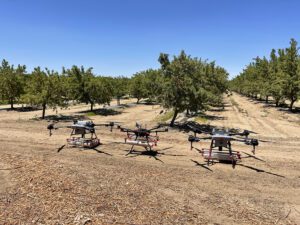
Drones
David Gan, CEO of TopGan Robotics, said the company was established in 2010 and formally registered in 2015. The company has more than 10 years of experience in the independent development and manufacturing of flight control systems, the core of UAV production.
“We design drones, we build drones, and we are designing the software for the drones, too,” Gan said.
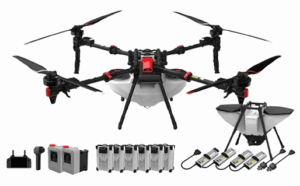
The company is the West Coast distributor of the XAG P150 Max.
According to Gan, the XAG P150 Max can perform a wide range of agricultural applications.
Unlike earlier drones, the P150 Max is designed as a multifunction agricultural platform capable of spraying, spreading and precision applications:
• Applying insecticides
• Spraying fungicides
• Applying herbicides
• Spraying foliar nutrients
• Applying plant growth regulators
• Performing spot treatments or full-field applications
The XAG P150 Max carries an 80-liter (21-gallon) spray tank and can adjust droplet size depending on the target crop and application.
With another attachment, the drone becomes a spreader capable of applying:
• Cover crop seed
• Granular fertilizer
• Soil amendments
• Pelleted pesticides
• Snail and slug bait
• Other dry granules between 1 and 10 mm in size
The spreader hopper has a rated capacity of 115 liters with an 80-kilogram payload.
Pollination
One of the newest applications for agricultural drones is artificial pollination.
In 2018 and 2019, XAG partnered with researchers at the South Australian Agricultural Research Center to test what it called its “Electronic Bees” concept. In these trials:
• Bees collected pollen from pollinizer trees.
• The pollen was mixed into a liquid formulation.
• XAG agricultural drones sprayed the pollen onto almond blossoms.
While pollination with Electronic Bees is still in the development stage, TopGan has seen promising results
in pistachios.
“We’ve been doing drone pollination for the last two years,” Gan said, adding the company has partnered with Acami Farms, a pistachio farm in California, to test pollination with drones.
Research
A pollination trial was conducted on a 100-acre plot that was divided into drone application, ATV application and control treatments.
Gan said the initial 100-acre trial produced encouraging results, prompting researchers to expand testing to 450 acres this season.
“This is an off year for pistachios,” Gan said. “It could be a good year for testing to see if we can improve yields in an off year.”
Researchers are using two different application methods with XAG platforms, one liquid and one powder.
TopGan has developed software that allows operators to define pollination parameters rather than pesticide parameters, including:
• Flight speed
• Release rate
• Row spacing
• Bloom stage
• Whether powder or liquid pollen is being applied
“The goal is not simply to spray pollen everywhere, but to place the right amount of pollen onto receptive flowers while minimizing waste,” Gan said.
Gan said the company developed AI software that works with multispectral cameras to identify when flowers are open, allowing growers to synchronize pollination applications with the optimal bloom stage.
The software provides an approximate indication of which trees need to be pollinated and how much pollen should be applied.
“We have another system that is the electrostatic system where we are putting electrostatic on the pollen, which helps it stick on the flowers,” Gan said.
Another trial was conducted in July to show growers results in the field just before harvest.
Bringing Drones to the Farm
Licensing for drone use has become more streamlined, Gan said.
“It’s a simple two-stage process, and the application is done online.”
The software is basic and simple to operate.
“It’s very reliable software. It’s operating with coordinated RTK GPS, so the drones are very accurate, and there’s a pretty short learning curve,” Gan said.
Custom drone applicators have been popular in the Midwest for the last three to four years. Gan has a company in California that provides custom drone services, but he said the practice is still not widely adopted in the region. He believes interest will continue to grow as prices and labor costs rise.
“Eventually it will catch up, and we will see a lot of growers using drones. They are more efficient. They are more reliable,” Gan said.
TopGan provides a week of field training with drone sales.
“Every field has different characteristics, so if you design the field one time on your GPS, most of the time it will work 100%. We go in there, and we survey with them,” Gan said.
The goal is not simply to spray pollen everywhere, but to place the right amount of pollen onto receptive flowers while minimizing waste. – David Gan, CEO, TopGan Robotics
Drones and Beneficial Insects
Parabug, based in Salinas, Calif., provides a cost-effective way to apply beneficial insects using drones to combat destructive pests, according to General Manager Jaclyn Bennett.
Custom Application
Drones are also changing the way growers release beneficial insects.
Parabug specializes in custom application and provides the beneficial insects, but Bennett said if a grower already has an established relationship with an insectary, the company will work with that supplier as well.
Growers can apply beneficial insects themselves, but most choose to work with a company specializing in beneficial insect applications.
“We focus on application of beneficial insects. The mechanism that we use is proprietary, and it was developed by us in-house. There are a number of independent operators who use Parabug equipment as well, but this equipment was developed specifically for applying beneficial insects,” Bennett said.
While other mechanisms can be mounted on drones, they were not specifically designed for beneficial insects. Bennett said some airframes on the market exert enough force to damage the insects during application.
“Working with a company that specializes in handling both on the ground as far as quality control, but also the application mechanism is incredibly important to make sure that you’re putting these bugs out safely and that they’re going onto your crop to live and to eat the pests that you’re targeting,” Bennett said.
“The materials that we’re using, typically in almonds, are predatory mites and green lacewings. Predatory mites specifically prey on pest mite species, while green lacewings are what we call generalist predators. They’ll feed on a variety of different insects,” Bennett said.
Growing Grower Interest
Interest from growers is increasing.
“The market really tends to fluctuate based on pressure and somewhat on the almond market itself,” Bennett said.
She said almond market challenges over the past few years slowed activity somewhat, but the company also has a strong presence in walnuts. Several research trials are underway in Northern California evaluating predatory mites for controlling pest mites.
Historically, predatory mites were used regularly before less expensive and more effective chemistries became available. With drone applications, Bennett said growers are returning to biological control tools.
Labor
Another factor is labor.
“Historically, beneficials have been applied by hand. So it’s a lot of labor, a lot of time, and it’s taking away the labor you do have from other on-farm tasks,” Bennett said.
Drone applications reduce labor and application costs while placing beneficial insects where they’re needed most.
“With the use of drones, we’re able to reduce application costs, and it’s also allowing growers to get those beneficials where they need them,” Bennett said.
Mite infestations typically begin in the tops of trees. Drones can deposit beneficial insects directly into the upper canopy where pests are most active.
Timing is crucial in a biological control program. Beneficial insects should be applied preventively at the first sign of pest activity rather than after populations become established.
Drone applications can typically cover about one acre per minute, compared to days required for hand application.
Publisher’s Take
The Big Picture: What to do Next
1. Agricultural drones are becoming true multiuse tools
Modern drones now spray crop protection products, spread fertilizer and cover crop seed, monitor crop health, inspect irrigation systems and create detailed field maps.
2. Drone pollination continues to advance
Researchers are testing both liquid and powder pollen applications in pistachios, with expanded field trials showing promising early results.
3. Artificial intelligence is improving precision
New software can identify bloom stage and help synchronize pollination applications while minimizing pollen waste.
4. Drone technology is expanding biological pest management
Specialized drone systems can release predatory mites and green lacewings into the upper canopy where pest pressure often begins.
5. Labor savings remain one of the biggest advantages
Drone applications can cover about an acre per minute while reducing labor demands and improving application efficiency.