 TM
TM
I‘ve been walking almond and pistachio orchards for 45 years, since I was a teenager driving my father’s spray rigs through cotton fields. I hold both a PCA and a CCA license, and that combination lets me work both sides of a field problem, pest pressure and agronomy, without handing a grower off to someone else. This August, with harvest running early and pest pressure climbing, I’m leaning on both sides of that license more than usual.

Hull Split Means the NOW Clock Has Started
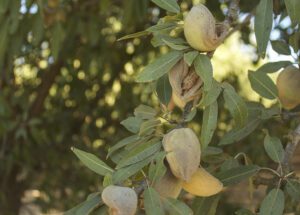
Once hulls start splitting on almonds and pistachios, navel orangeworm becomes the thing I’m watching most closely. My trigger point is precise. At roughly 1% hull split, I start covering the nuts with an application, then I follow up again about two weeks later.
Even with good coverage and strong insecticides, growers should expect no better than 50% control from in-season sprays alone. The real work happens months earlier. You’ve got to have started navel orangeworm control back in the dormant period with mummy shaking and cleanup. When I find orchards with high mummy counts during dormant-season scouting, I tell growers straight out what they’re facing. I level with them. I tell them there’s a whole lot I can do for them, that I can reduce the damage, but I can’t eliminate it, no matter how many sprays we run.
Pistachios complicate the timing further. True hull split arrives later than in almonds, but early splits, what I call pea splits, can open the door to a navel orangeworm generation well ahead of the main split. If I’m seeing egg-laying activity on those early splits, I may need to treat sooner than planned, which usually means an extra spray pass.
Hull Rot Is a Disease of Excess
When growers ask me whether a hull problem can be solved with a change in irrigation, I start with diagnosis. Hull rot is fundamentally a disease of too much: too much nitrogen, too much water and orchards kept too vigorous and too green.
Managing it through deficit irrigation is a narrow path. Without a pressure bomb to track tree water status, most growers are working blind, and few are willing to invest the labor and time a pressure bomb requires. Push too hard on deficit irrigation and you risk damaging next year’s crop. Don’t push hard enough and hull rot persists.
You can usually tell which orchards are going to have these issues. They’re your most vigorous, the big trees, the ones growing really well. Sprays help, but they aren’t the full answer.
The Biggest Mistake I’m Seeing Right Now
With this year’s harvest arriving early, the mistake I’m seeing most is growers delaying their first shake because the crop still looks green. I’m skeptical that delay is justified. The longer we leave them on the tree, the longer we’re exposed to navel orangeworm, and the more damage we’re going to get. I’m not seeing a lot of growers shaking just yet. I think late shaking is going to catch up with us this year.
One Thing Every Grower Should Do This Month
Regardless of crop, I push every one of my growers to pull hull samples for boron analysis right now. Tissue samples collected in July don’t give accurate boron readings, and boron deficiency has become a widespread limiting factor, particularly in older, established orchards. You don’t know what your boron levels are unless you take a hull sample right now. That’s something I push all growers to do.
Gary Osteen can be reached at gwosteen@aol.com or at (661) 333-5551.
Publisher’s Take
The Big Picture: What to do Next
1. Don’t rely on sprays alone
Dormant mummy removal remains the foundation of effective navel orangeworm management.
2. Time NOW sprays carefully
Begin applications around 1% hull split and follow with a second spray about two weeks later when needed.
3. Avoid excessive orchard vigor
Too much nitrogen and water increase the risk of hull rot.
4. Don’t delay harvest unnecessarily
Waiting because almonds still appear green may increase exposure to navel orangeworm.
5. Pull hull samples now
Hull samples provide the most accurate boron readings and help identify deficiencies before next season.