 TM
Leaving Eastern filbert blight-infected chippings on orchard floors is a viable alternative to burning or hauling them away and can enhance soil health, according to retired Oregon State University plant pathologist Jay Pscheidt.
As a new race of Eastern filbert blight (EFB) spreads across the Willamette Valley to formerly resistant hazelnut trees, Pscheidt revisited EFB management strategies, including what to do with pruned material, during a presentation at the Nut Growers Society Summer Tour Aug. 5 in Albany, Ore.
For many growers, the presentation was a rehash of information they learned while managing for EFB before EFB-resistant trees were introduced in the late 2000s. For others, those who entered the industry after EFB-resistant trees came to dominate the landscape, it was potentially new information. The new race of EFB, Race 1, which has overcome the resistance formerly conferred in multiple cultivars now widely planted in Oregon, was first discovered in the winter of 2021-22 and is now widespread in the Pacific Northwest.
“We have found this new fungus throughout Oregon, Washington and British Columbia. It has popped up just about everywhere and it is of concern.” — Jay Pscheidt
Managing for EFB is difficult in large part because of the disease’s lengthy latency period, Pscheidt said. Infected trees typically won’t show symptoms for more than a year after infection.
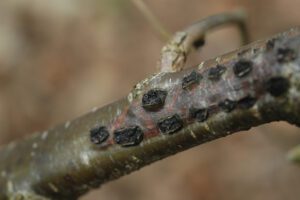
“This is a weird disease. It doesn’t kill right away. It will kill the cambium right underneath where you see that canker, but on either side, it is still alive, and that shoot will continue to be alive for quite some time before you see the pustules,” he said.
Disease management often comes down to scouting, cutting out infected material and applying fungicides.
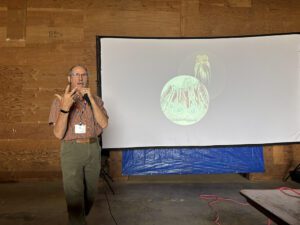
“You can’t tell me you don’t have it if you don’t go looking for it,” Pscheidt said. “And if you find it, cut it out. I don’t care when that is. An old pathologist said the best time to cut it out of a tree is when the saw is in your hand. That is the only thing that will get this canker disease out of a tree. And you have to cut far enough below the canker. If you cut right at the base of a canker, it will keep on going.”
Pscheidt advised growers to cut one to three feet below a canker when pruning infected material. “I realize that for some of those small trees, especially the Gasaway trees, it might be the whole tree that goes,” Pscheidt said. “That might be what has to happen.”
As for disposing of the pruned material, Pscheidt said researchers have found that chipping it and leaving it on orchard floors could be a good option, particularly because it did not lead to additional infection and the practice can improve soil health. “We could see that there were spores coming out of (the chipped material), but when you look at the data, we didn’t get infection,” Pscheidt said. “So, grind them up small so the material doesn’t interfere with harvest. It will be good for the soil health to leave all that material in the orchard.”
Fungicide Program
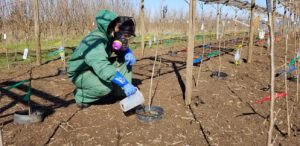
Outside of planting resistant trees, preventing EFB from gaining a foothold in orchards involves aggressive fungicide spray programs. Pscheidt said programs should begin roughly at bud break and continue at two-week intervals for the next six to eight weeks, depending on weather conditions.
At times, growers may need to begin the program early. “If you’re at 40% bud break and you’ve got a weather front coming in, I’d be getting out there with a spray,” Pscheidt said.
Pscheidt said it is important to alternate fungicides and use materials from different FRAC (Fungicide Resistance Action Committee) groups over the course of a season. He noted that fungicides from FRAC Group 3 and FRAC Group 11 have performed well against EFB, while the Group 7s “have not done real well.”
A standard program might involve starting with a nonsystemic material, such as Bravo or Ziram, and moving to more systemic materials as leaf tissue expands. “At bud break, there is not a lot of leaf tissue out yet, and so that’s why I prefer to use the Bravo and get good coverage with that. Once we get a little more leaf tissue out there, come in with those systemic materials, like Flint or Tilt or Cabrio.”
Flint and Cabrio are FRAC Group 11 materials, while Tilt is a Group 3 material. Bravo is an M5 material.
If tank mixing, Pscheidt said a full rate of a Group 3 material with a half rate of an M5 material can be effective, as can a half rate of a Group 11 material with a half rate of an M5 material.
“You need to keep the Group 3s at full rate,” he said. “That is for resistance management. But you can cut the Bravo rate. You can use a half rate of Group 11s and a half rate of Bravo. That will work.”
If growing organic hazelnuts, he said to consider using copper sprays, noting that biologicals have not been particularly effective against EFB.
Spray Techniques
Research has shown that applying fungicides by ground at a dilution rate of 100 gallons per acre or more provides the best coverage, Pscheidt said. “But that doesn’t mean you can’t fly it on. You can certainly put it on by plane or by helicopter. And I’m interested to see how the data is going to come in on drones. That will probably be just fine, as well.”
Alternate-row spraying can be effective early in the season, particularly on the first spray, before shoots begin to grow out. “You get a little less coverage, but it should be effective,” Pscheidt said. “By the time we’re into May, you’re getting significantly less coverage, so please don’t be doing alternate row spraying that late in a year.”
Research has shown that disease protection improves for the first four treatments. After that, the protection flattens out. In dry years, growers may be able to reduce the number of treatments.
“The only time you’re going to get spores out is when it’s raining,” Pscheidt said. “If it gets to the point in the springtime when it’s not raining and it doesn’t look like there is significant rain coming along, you won’t need the fungicides.”
Cultivars that have been infected with the new EFB race include Jefferson, Yamhill, PollyO, McDonald, Wepster, Theta and Dorris. Infection has been found at multiple sites in the northern Willamette Valley, including Woodburn, St. Paul, Gaston, Amity and Silverton, as well as elsewhere in the Pacific Northwest, including Chehalis and Salkum, Wash., and British Columbia.
“We have found this new fungus throughout Oregon, Washington and British Columbia,” Pscheidt said. “It has popped up just about everywhere and it is of concern.”
Pscheidt, who retired June 30, noted that new research is showing that drenching young trees with the fungicide TopGuard also may provide an alternative control method. Applied at a rate of 14 fluid ounces starting at bud break, researchers achieved 99% control for the year. When increasing the rate and applying prior to bud break, researchers were able to achieve 96% control in year one and also had 95% control in year two.
Pscheidt plans to continue with that research.
Publisher’s Take
The Big Picture: What to do Next
1. Scout even when trees look healthy
EFB can remain latent for more than a year, making regular scouting important even before symptoms are obvious.
2. Cut well below visible cankers
Pscheidt recommends pruning one to three feet below a canker to remove infected tissue.
3. Time fungicides around bud break
Programs should begin roughly at bud break and continue at two-week intervals for six to eight weeks, depending on weather conditions.
4. Rotate FRAC groups
Alternating fungicide groups over the season is an important part of resistance management.
5. Adjust coverage as the canopy develops
Alternate-row spraying may work early, but Pscheidt cautions that coverage drops as shoots and foliage expand.