 TM
TM
Cover crops often contain a mixture of plants that fall into one of four groups: legumes, brassicas, forbs and grasses. Legumes, which include beans, fix atmospheric nitrogen. Brassicas, the mustard family, are known for their excellent compaction-busting properties, early flowering and toxicity to nematodes. Forbs are a broad range of plants that include any herbaceous broadleaf plant species that is not a grass, rush or sedge. A forb can add a specialized trait to a cover crop, like lacy phacelia’s skill in nitrate interception or sunflower’s ability to bioaccumulate heavy metals. The final group on the list is grasses. Grasses come from the family Poaceae and include easily recognized species like wheat and corn, short-statured lawn grasses and giants like bamboo. Having annual and perennial species, grasses have adapted to grow in nearly every environmental condition.
Grasses provide a number of characteristics that are beneficial in cover cropping. The following is a generalized overview.
Most species used in the practice are quick to germinate and establish. This rapid growth allows grasses to quickly fill in an area, providing weed suppression, erosion reduction and soil protection. Oftentimes, grasses are among the first seeds to sprout, beating most species with the notable exception of brassicas.
The narrow, blade-like body shape of grasses allows them to fill in gaps in the cover crop canopy that would otherwise be left open. This creates multiple benefits, such as increased cover crop biomass production and blocking sunlight from reaching the soil surface. Reducing the amount of light on the soil reduces the number and strength of weed seedlings.
Grasses can act as a structure for slower-growing, vining species to climb, such as vetch. This increases the amount of legume biomass, which increases the total fixed nitrogen, and keeps rot-prone species off the ground and out of damp conditions, which is a common issue for peas.
Benefits Below Ground
The benefits of grasses extend below ground as well. Grass roots are known for being numerous and fibrous. This growth pattern allows grasses to hold soil particles together like nets, reducing erosion and building soil stability. The root exudates from grasses promote a host of microorganisms, which increases population diversity and resiliency. This greater diversity increases competition with, and the suppression of, plant-pathogenic microorganisms.
Despite their many benefits, there are a number of considerations when selecting a grass for a cover crop. A main factor to keep in mind is spring- and winter-type grasses. This distinction describes when the grass is most active and when it will send up seed heads. This affects cover crops in how much biomass is produced in each season and when they are best terminated.
Spring vs. Winter Grasses
Throughout most of the world, spring grains are planted after winter. They grow quicker than their winter counterparts and can tolerate warmer temperatures. Winter grains are planted in the fall, ride out the winter and mature in the spring. The greatest difference is the requirement for vernalization.
In California, both winter- and spring-type grasses can be planted in the fall. Winter varieties will often stay short throughout the colder months, which can be beneficial for those with frost concerns. They can also take longer to mature, meaning the farmer can get up to an additional month of growth before the grass sends up seed heads. However, this means they can be more difficult to terminate if the farmer needs to mow the cover crop before seed heads have emerged.
Spring grain types do not require vernalization and will mature earlier. Additionally, they can be used to produce more biomass in a shorter period than their winter counterparts. This earlier maturity means they will be easier to terminate when most farmers in California plan to mow their cover crops.
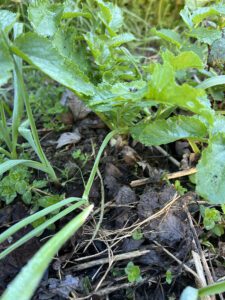
Grass roots are known for being numerous and fibrous, reducing erosion and building soil stability.
Choosing the Right Species
Aside from winter and spring typing, and the general benefits of grasses, individual species can present their own unique advantages and disadvantages. For instance, some grasses, like cereal rye, are excellent at reducing nitrate leaching but can prove more difficult to control. Oats can provide great fall growth but are far less able to withstand winter conditions. Other grasses are more generalized, performing well in a variety of conditions while not proving particularly exemplary in a single trait.
Grasses like triticale fit this description, which has made them highly popular in cover crop mixes, including Seeds for Bees’ Nitrobuilder blend.
Also of note is the distinction between ryegrass and rye grain, or cereal rye. Rye is a unique member of the domesticated grasses in that it was domesticated by selection pressures in Russian wheat farming. Rye was a persistent weed in wheat fields, and the survivors were the plants that possessed traits similar to the wheat they grew with. Over time, rye came to share so many traits with wheat that it became its own crop.
This history is important to note because there are several other ryes that were not developed for grain production and can become weed issues later. This can be avoided by selecting cereal rye or rye grain rather than selecting a ryegrass for the cover crop.
Timing Matters
Another important factor when choosing a grass to add to the cover crop is when it sends up a seed head and how that aligns with pod formation in the other species. The best time to terminate a cover crop is when the plants have begun setting seed. This is when they are green enough to terminate easily while having expended enough energy to have difficulty regrowing.
In addition to maturity timing, the relative size of the seeds can also be a contributor. Seed mixes that contain widely varying seed sizes are more difficult to plant and run through machinery compared to more homogeneous blends. Large seeds often require deeper planting depths than smaller seeds. This can create a situation where stand strength is affected, with some or all of the seeds being planted at the incorrect depth. Grasses like triticale and rye usually have smaller seeds than wheat and oats. This makes the smaller grains more compatible with small-seeded plants like brassicas.
Some grasses can have allelopathic tendencies, which can either prove beneficial or detrimental. Allelopathy is when a plant produces compounds that are toxic or harmful to other plant species. For example, cereal rye produces compounds that are toxic to other grasses. This can be used to help suppress grass weeds or could harm a following cash crop like corn. Being aware of this tendency can help a farmer take advantage of this trait or avoid economic harm. Understanding when and for how long this trait can occur is also a factor.
California farmers can receive cover crop advice from the Seeds for Bees program when selecting cover crops.
Those interested in using cover crops and located in California can do so by applying to the Seeds for Bees program. The application is short, easy to complete and does not require the submission of additional documentation. To find the application, go to the Project Apis m. website.
Publisher’s Take
The Big Picture: What to do Next
1. Grasses are foundational cover crop species
They provide rapid establishment, weed suppression, erosion control and soil protection.
2. Grass roots improve soil health
Fibrous root systems help stabilize soil and support beneficial microbial activity.
3. Choose spring or winter types carefully
Growth patterns and termination timing vary significantly between the two.
4. Species selection matters
Cereal rye, oats and triticale each bring different strengths and management challenges.
5. Termination timing affects success
Cover crops are generally easiest to terminate and least likely to regrow when seed heads begin to form or mid flowering.