 TM
TM
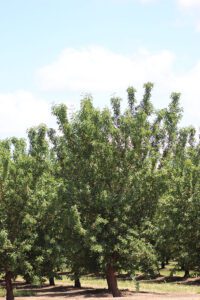
Unless you are planting a new almond orchard at the site of a previous successful orchard and continuing with what worked there, plenty of decisions will be needed to ensure the new trees have a long and productive life.
Considering the expense of planting a new orchard, making sure the trees make it to their second decade is important.
“That’s where you make your money,” Franz Niederholzer said.
Almond orchards are typically removed in the 20- to 25-year range as tree numbers and yields decrease.
Whether the proposed orchard site is a replant or new ground, “you’ve got the ground you’ve got,” said Reid Robinson.
“Think about why the previous orchard there was taken out,” Robinson said.
If the previous orchard there was not successful, he advised choosing rootstocks that minimize the problems and have traits that work for the location and soils.
“Choose rootstocks that are best suited to that location,” Robinson said.
Resistance to Phytophthora and band canker should be part of the decision in some areas where anchorage is important in other parts of the state.
There is also the “unforced error” in choosing rootstocks that support good tree architecture and can withstand shaking at harvest.
Minimizing tree losses due to diseases means the orchard will still be viable in its second decade.
An example would be avoiding Hansen for orchard longevity due to it being highly prone to Phytophthora, crown gall and poorer anchorage.
Robinson said SG1 or BH-5 are better options for longevity. Krymsk in the northern growing regions would also provide extra years of production.
Burchell Nursery’s Tom Burchell said getting young orchards off to a good start can mean foregoing early production to establish a good tree structure early.
Sound scaffold selections can hold a heavy crop.
Rootstock selection can also be critical. Burchell noted that the newer peach hybrids will provide good anchorage and vigor.
Starting With New Ground
If the intended orchard site is new ground, Niederholzer said the soil should be well-drained with no standing water or perched water tables.
He also noted that finding perfect ground for planting a new almond orchard is not always possible and, considering land costs, a grower might have to compromise.
Mitigation strategies include doing much more site preparation, laser leveling for runoff, berms or islands or mounds and careful rootstock selection.
“It is great to find a perfect site, but the reality is that you are probably going to need to do more to overcome some unfavorable conditions.”
Robinson said location of the site also must be considered.
Almond crops can be vulnerable to frost and blossom blast on some valley floor locations.
In addition to site preparation, there are considerations for orchard design.
One of those is matching rootstock with tree spacing decisions.
Niederholzer said rootstock and variety will dictate size of the tree at maturity.
Canopy management also plays a key role in orchard longevity, Robinson said.
Canopy management means maximizing light interception, ensuring structural strength to prevent tree failure and maintaining productive wood.
Pruning aims to allow light to move down into the canopy and sustain lower fruit wood.
Challenges in the South
There are some unique challenges where almonds are planted in the southern half of the valley.
Mohammad Yaghmour said longevity of an orchard will depend on the plans for the site and how growers will mitigate stress.
“You have to be aware of soil types and the abiotic and biotic challenges at your chosen orchard site,” he said.
Salinity in the soil and water is an abiotic stressor that can limit trees’ ability to take up nutrients and water.
Poor-quality water can cause infiltration problems, reducing infiltration due to surface crusting and clay dispersions.
Prior to planting, a grower should be aware of irrigation water quality.
Management strategies would include flushing salts from the root zone.
Nematodes in the orchard soil are biotic stressors that can weaken root systems and not allow vigorous tree growth in the early years.
Canopies will be diminished and yields will be affected.
Choosing rootstocks that are resistant or tolerant of specific challenges in the site is important, Yaghmour said.
For example, he said that in areas where high winds are prevalent, rootstocks that provide good anchorage are necessary.
Diseases can rob trees of productive years.
In areas where Phytophthora is a problem, the decision to plant trees on berms can keep water from pooling around tree trunks and introducing this pathogen.
Careful scaffold selection when trees are young is another way to prevent cankers.
The fungal disease Ganoderma adspersum can be prevented by reducing tree injury from machinery.
Once an orchard has been planted, Yaghmour said irrigation management can also prevent stress by applying water according to tree needs.
“Decisions made in the planning stage of an orchard and management during their productive years will help keep an orchard viable,” he said.
The Almond Board of California notes the overall goal is to maximize resource capture and optimize resource use to achieve sustainable economic yields. Orchards planned and planted with that goal in mind will have the most productive years.
Those resources are light, carbon, hydrogen and oxygen for creating carbohydrates, water and mineral nutrients. Early almond orchard yields are dependent on rapid establishment of large canopies to intercept light for photosynthesis, along with healthy populations of spurs for bearing fruit. This needs to be balanced against the need to establish a strong tree framework that can bear large crops and be efficiently managed for the long term.
Early tree training will have a lasting impact during the life of a tree.
ABC-funded research notes that the larger the tree will eventually be, the more critical it is to get early training right.
This is where scaffold selection plays a part.
Scaffolds chosen should be strong, well-anchored branches that will not break or split from the trunk with the weight of future crops. The selection should be based on angle, spacing and orientation. Strong scaffold branches will better hold the weight of a heavy crop.
Publisher’s Take
The Big Picture: What to do Next
1. Rootstock selection can determine orchard longevity
Choosing rootstocks suited to soil conditions, disease pressure, salinity and wind exposure can add productive years to an orchard’s life.
2. Early tree training matters long term
Strong scaffold selection and proper canopy structure in the first few years help prevent breakage and sustain yields later in the orchard’s life.
3. Site preparation can offset poor ground conditions
Berms, laser leveling and drainage improvements can help mitigate standing water, salinity and infiltration issues.
4. Water quality and salinity should be evaluated before planting
Poor-quality irrigation water and salt accumulation can limit nutrient uptake, weaken trees and reduce long-term productivity.
5. Stress prevention is critical to keeping orchards productive into their second decade
Disease management, irrigation scheduling and minimizing trunk and scaffold injury all contribute to orchard longevity.

Cecilia Parsons | Associate Editor
Cecilia Parsons has lived in the Central Valley community of Ducor since 1976, covering agriculture for numerous agricultural publications over the years. She has found and nurtured many wonderful and helpful contacts in the ag community, including the UCCE advisors, allowing for news coverage that focuses on the basics of food production.
She is always on the search for new ag topics that can help growers and processors in the San Joaquin Valley improve their bottom line.
In her free time, Cecilia rides her horse, Holly in ranch versatility shows and raises registered Shetland sheep which she exhibits at county and state fairs during the summer.